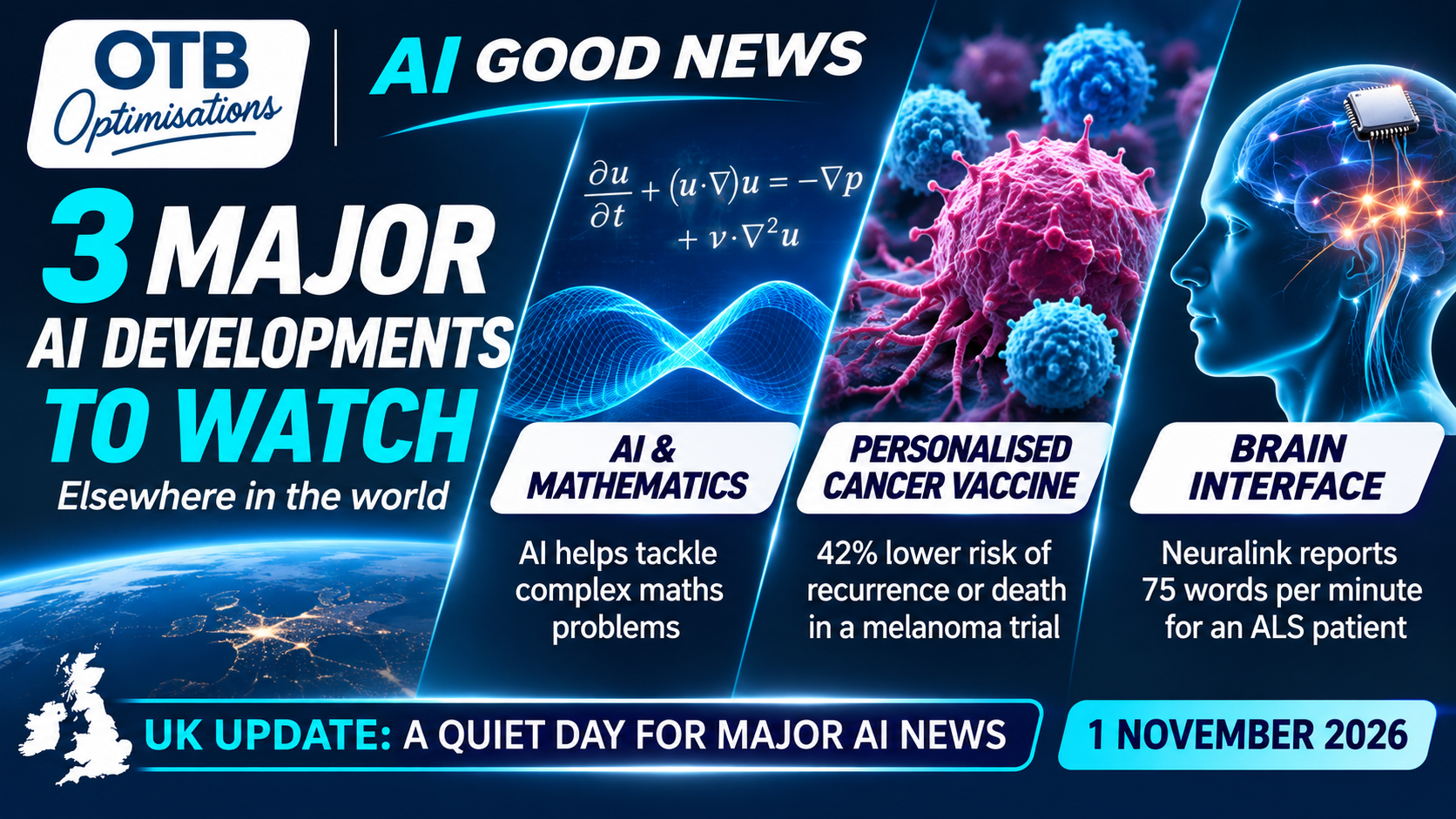
🇬🇧 It’s been a relatively quiet 24 hours for major new AI breakthroughs here in Britain.
But that doesn’t mean the rest of the world has stopped making progress!
One person I follow closely is Dr Alex Wissner-Gross, an AI researcher and entrepreneur whose regular updates bring together some of the most fascinating developments happening across artificial intelligence, science and technology.
His latest episode, Welcome to Halloween 2026, published on 31 October, highlighted several stories that caught my attention.
I’ve taken three particularly interesting developments and looked more closely at the evidence behind them.
And they involve something rather extraordinary: AI helping mathematicians tackle difficult problems, personalised cancer vaccines delivering encouraging clinical results, and brain implants helping people with paralysis communicate.
These developments weren’t all announced yesterday, but they’re worth understanding.
🧠 1. AI Is Helping Mathematicians Tackle Problems That Have Challenged Humans for Generations
Imagine giving artificial intelligence a mathematical problem that has challenged some of the world’s greatest minds.
Now imagine it helping produce a solution.
That is increasingly what researchers are reporting.
In September, OpenAI announced that an internal AI system had generated a proposed solution to the famous Navier-Stokes existence and smoothness problem, involving the mathematics of fluid motion.
The team also released a computer-formalised proof using Lean, a system designed to check mathematical reasoning.
Meanwhile, Anthropic reported that Claude had largely autonomously produced a complete computer-checked formalisation of Fermat’s Last Theorem in just 11 days.
There’s an important distinction here.
Fermat’s Last Theorem had already been proved by mathematician Andrew Wiles. Anthropic’s achievement was translating that established mathematics into a form that computers could verify.
OpenAI’s Navier-Stokes claim concerns a proposed resolution of a previously unsolved problem, but such an extraordinary result requires careful independent scrutiny.
Why does this matter?
Mathematics underpins engineering, physics, medicine, computing and countless technologies we rely on.
If AI can help discover new mathematics and verify complex proofs, it could eventually accelerate scientific research across many different fields.
This is still a developing area, but the possibilities are fascinating.
❤️ 2. Personalised Cancer Vaccines Deliver Encouraging Results
This is the development that really caught my attention.
Researchers have reported encouraging results from a large clinical trial involving a personalised mRNA cancer vaccine.
The experimental treatment, called intismeran autogene, is designed specifically around the genetic characteristics of an individual patient’s tumour.
Rather than using one identical vaccine for everyone, scientists analyse the cancer’s mutations and create a treatment intended to help the immune system recognise those particular cancer cells.
In a Phase III trial involving 1,137 patients with high-risk melanoma, researchers found that adding the personalised vaccine to the immunotherapy drug pembrolizumab reduced the relative risk of cancer recurrence or death by 42% compared with pembrolizumab alone.
That is a substantial result.
It doesn’t mean 42% of all patients were cured, and it doesn’t establish that the treatment improves overall survival.
But it is encouraging evidence from a large randomised trial.
One important clarification: this is a breakthrough in personalised medicine, but the published trial result does not, by itself, establish that AI caused the improvement.
The treatment remains experimental, with further assessment and follow-up needed.
Still, the idea of creating cancer treatments tailored to an individual person’s tumour is genuinely exciting.
🗣️ 3. Brain Implants Are Helping People Communicate Again
Now imagine being fully conscious, knowing exactly what you want to say, but being unable to speak because of a condition such as ALS.
For some people, that’s a devastating reality.
Brain-computer interfaces are being developed to help bridge that communication gap.
Neuralink has recently reported that one participant with ALS achieved a communication rate of approximately 75 words per minute during early testing.
The technology aims to interpret signals from the brain and translate them into computer output, potentially allowing people with severe paralysis to communicate more naturally.
That’s an extraordinary possibility.
However, the 75-word-per-minute figure currently comes from company reporting, rather than a fully independently validated clinical publication establishing its reliability across patients.
It’s also important not to confuse experimental communication systems with a cure for ALS or paralysis.
Nevertheless, helping someone communicate when they have lost the ability to speak could be one of the most meaningful applications of advanced computing and AI.
🌍 What Connects These Three Stories?
These developments are very different.
One concerns mathematics.
Another involves cancer treatment.
The third could help restore communication for people living with devastating neurological conditions.
But they share something important.
They’re examples of technology being directed towards problems that genuinely matter.
Not all the results are equally established.
The cancer vaccine has encouraging Phase III clinical evidence. The mathematical claims require different forms of technical validation. Neuralink’s latest communication figures need further independent clinical scrutiny.
And that’s why checking the evidence matters.
I follow researchers such as Alex Wissner-Gross because they help draw attention to developments that might otherwise go unnoticed.
But I also believe it’s important to look beyond the headlines and understand what has actually been demonstrated.
There may not be a major new UK breakthrough to report this morning.
But around the world, researchers are continuing to explore ways technology could improve health, scientific understanding and people’s quality of life.
And that’s something worth keeping an eye on.
Sources and further reading
- Dr Alex Wissner-Gross, Welcome to Halloween 2026, 31 October 2026.
- OpenAI, On the Navier-Stokes Millennium Prize Problem, 8 September 2026.
- Anthropic, Formalizing Fermat’s Last Theorem, 4 September 2026.
- The Institute of Cancer Research, London, Personalised melanoma vaccine results, 23 October 2026.
- Cancer Discovery, personalised mRNA vaccine trial report, 26 October 2026.
- TeslaNorth, Neuralink Says One ALS Patient Hit 75 Words a Minute, 28 October 2026.
Less hype. More real-world AI progress.