Today’s UK AI Good News is a little different.
There haven’t been loads of major UK breakthroughs in the last 24 hours, and rather than fill the page with weak stories, I’ve picked two genuinely interesting UK developments plus one significant piece of research from overseas.
And all three demonstrate the same thing: some of AI’s most interesting applications aren’t about replacing people. They’re about giving people better information.
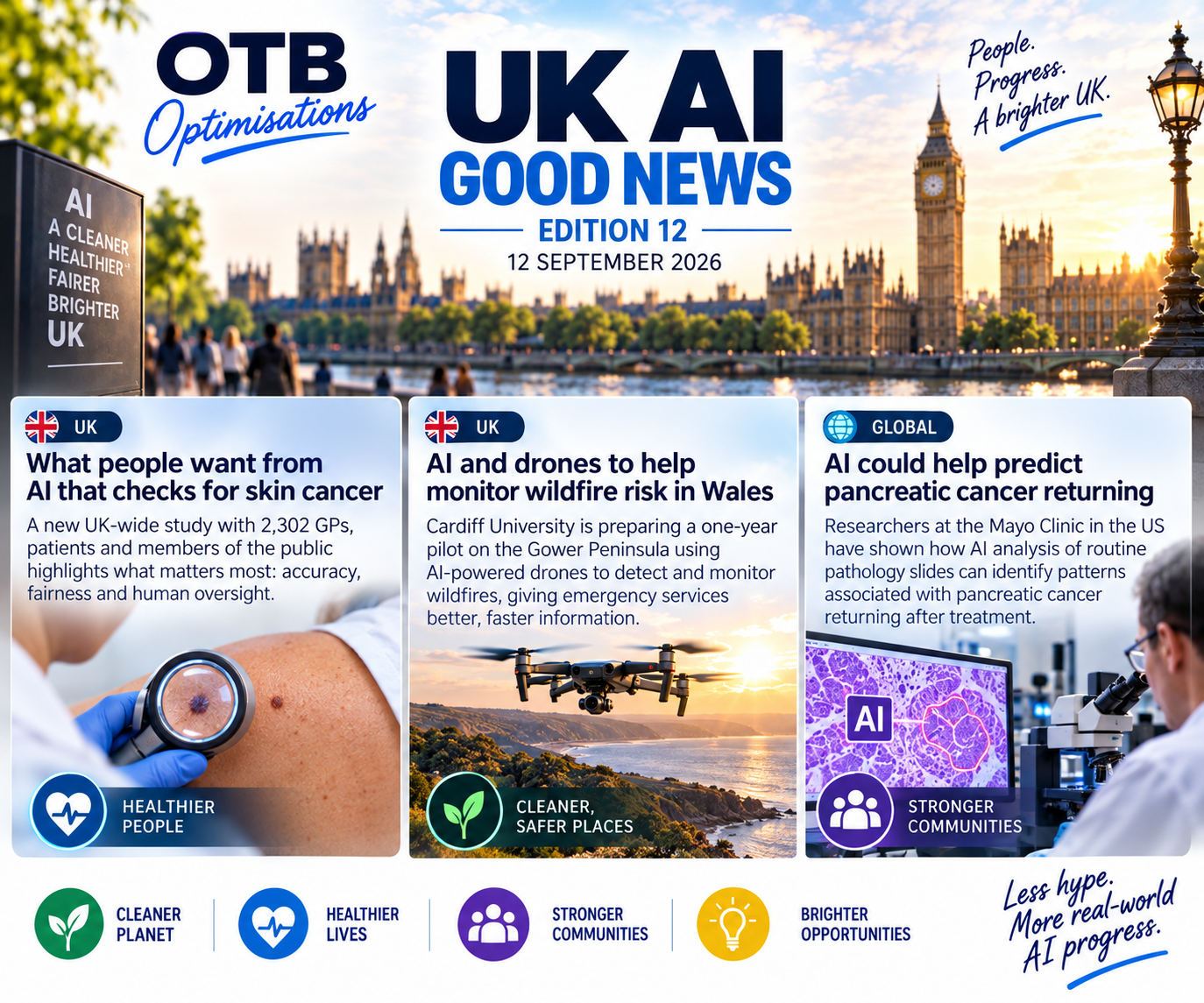
What do people actually want from AI that checks for skin cancer?
A new UK-wide study involving 2,302 people, including GPs, patients and members of the public, has investigated what people actually want from AI systems designed to help identify suspicious skin lesions.
The biggest priority was clear: don’t miss cancers.
Avoiding false negatives, where an AI system incorrectly reassures somebody whose lesion may actually be cancerous, was the most important consideration across all three groups.
Another major priority was ensuring the technology had been developed and tested across different skin tones.
Interestingly, participants also generally preferred AI being used alongside a healthcare professional in a GP surgery rather than people relying on an AI system themselves at home.
That gives developers and the NHS some useful evidence about how people want medical AI introduced: accuracy, fairness and human oversight matter.
Source: University of Cambridge — Research into AI for suspicious skin lesions and skin-cancer detection ↗
AI and drones could help monitor wildfire risk in Wales
Researchers at Cardiff University are preparing a one-year pilot on the Gower Peninsula combining drones, advanced sensors and artificial intelligence.
The drones can carry thermal and optical cameras capable of identifying hotspots that may be difficult to see from the ground.
AI can then analyse this information alongside weather, terrain and environmental data.
The aim is eventually to help identify areas at greater risk and provide emergency responders with better information as a wildfire develops.
Importantly, this isn’t about replacing firefighters.
It’s about giving emergency teams faster and potentially safer access to information, particularly when reaching an area on foot could be difficult or dangerous.
The pilot is due to begin in October 2026.
If successful, what researchers learn in Wales could eventually have applications elsewhere in the UK and internationally.
Source: Cardiff University — Welsh wildfire risk to be assessed by aerial drone technology ↗
And one from around the world… AI could help predict pancreatic cancer returning
This one comes from researchers at the Mayo Clinic in the United States.
Researchers have been studying whether AI analysis of routine pathology slides could reveal which pancreatic cancer patients are at greater risk of their cancer returning following treatment.
Rather than simply looking at how much cancer remains following chemotherapy and surgery, the AI examines how remaining cancer cells are spatially organised within the surrounding tissue.
Researchers found that particular patterns were associated with earlier recurrence.
That’s potentially important because it could eventually provide doctors with another way of identifying patients who may require closer monitoring or different treatment strategies.
The research was published in Clinical Cancer Research.
Source: Mayo Clinic — AI-enabled pathology analysis and pancreatic-cancer recurrence ↗
Why this matters
Three very different stories. One common theme.
The interesting question about AI is increasingly becoming less:
“Can AI replace someone doing this?”
And more:
“Can AI give someone better information to make a better decision?”
A GP assessing a suspicious skin lesion.
A firefighter trying to understand what’s happening in a dangerous area.
An oncologist deciding how closely a cancer patient needs to be monitored.
That’s the AI progress worth watching.
Less hype. More real-world AI progress.