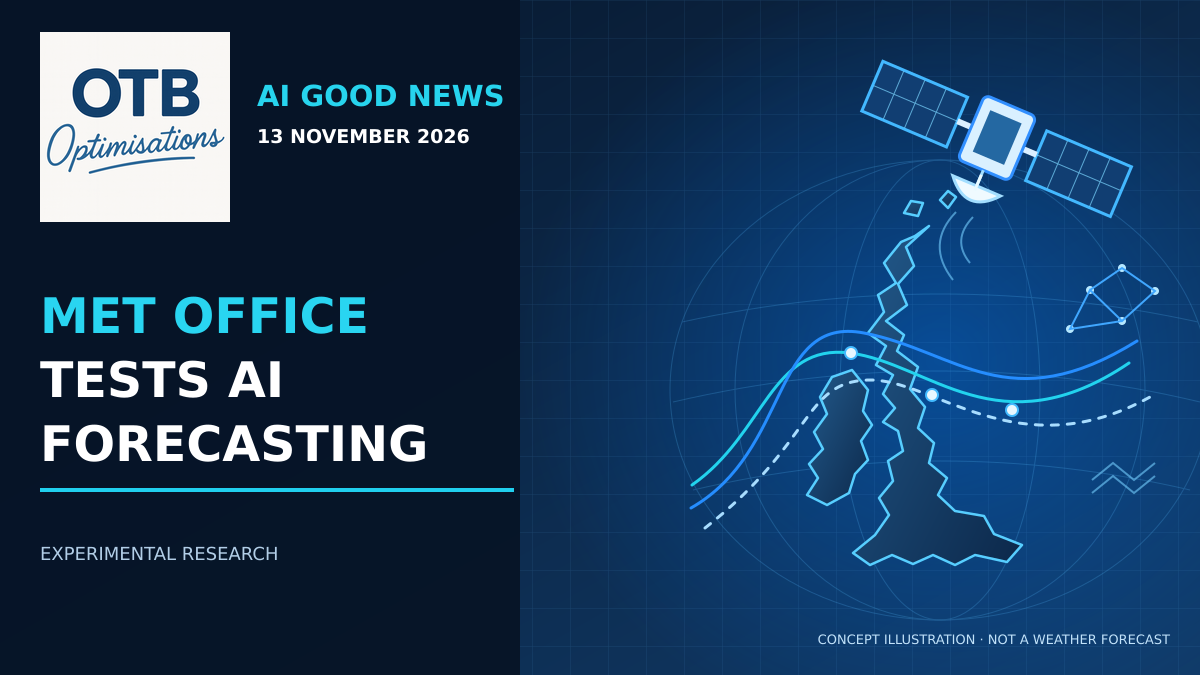
Better weather forecasting is not just about knowing whether to take a coat. It can help communities prepare for dangerous rain, give coastal businesses more time to plan and help electricity systems respond to changing wind and sunshine. A new UK research agreement will explore whether AI can give expert forecasters another useful tool.
In an announcement published on Thursday 12 November 2026, the Met Office said it is evaluating Google’s WeatherNext 3 under a new multi-year agreement. Its scientists will assess the machine-learning model in experimental research environments, looking at how it could complement existing forecasting systems.
The important distinction is that this is an evaluation, not an operational launch. WeatherNext 3 is experimental in this Met Office work and is not being used to issue operational weather warnings. The announcement does not establish that it improves the Met Office’s official forecasts.
How traditional weather forecasts work
Modern forecasting starts with observations of the atmosphere. Numerical weather prediction uses those observations to help describe current conditions, then calculates how the atmosphere may develop using physical laws on high-performance computers.
Those calculations represent processes such as air movement, heat transfer and changes in moisture. They are demanding because weather systems interact across different scales, from large pressure systems to local showers, and because the starting observations can never describe every detail perfectly.
The Met Office says this physics-based approach remains the foundation of its forecasting and underpins the National Severe Weather Warning Service. Testing AI does not mean abandoning that foundation.
What AI ensemble scenarios could add
AI weather models take a different approach. Trained on historical records and observational datasets, they learn patterns that allow them to generate possible future weather conditions. According to the Met Office, AI models can produce global, multi-day scenarios in minutes, with relatively light computing requirements at the forecasting stage. That is not a claim that developing or training them is cost-free.
An ensemble is a collection of possible scenarios rather than one supposedly certain prediction. Looking across different outcomes helps forecasters explore uncertainty: whether a storm might follow several plausible tracks, for example, or whether a heavy-rain signal appears consistently or only in a few scenarios.
Traditional forecasting already uses ensembles. The potential contribution from AI is faster exploration of additional possibilities alongside physics-based systems, not the invention of probabilistic forecasting. A rapid scenario is only valuable if its probabilities and weather patterns are sufficiently reliable for the decision being made.
The Met Office says WeatherNext 3 includes direct use of live satellite and observational feeds for rapid updates, high-resolution spatial outputs and advanced probabilistic techniques. These are capabilities it will assess in experimental sandboxes, not a declaration that the model has passed every test needed for public forecasting.
Why rainfall, storms and coastal conditions matter
The research could help meteorologists explore early signals of intense convective rainfall, where heavy downpours can develop over relatively small areas. Faster scenario generation could also help them examine how fast-moving weather systems or storms might develop. Neither possibility amounts to proof of better storm warnings or reliable street-level rain predictions.
Higher-resolution outputs could potentially support analysis of local terrain and the boundary between land and sea around the UK. Coastal conditions are particularly sensitive to where a weather system travels and how it interacts with the landscape. The announcement does not demonstrate improved coastal flood or storm-surge predictions, and it should not be read as doing so.
These are useful research questions because severe weather decisions depend on both the likely conditions and the uncertainty around them. More scenarios alone do not make advice more accurate. Scientists still need to establish when an AI model adds useful information and when its output could mislead.
A possible benefit for renewable energy
Wind and solar generation change with the weather. The Met Office identifies refined surface-wind and solar guidance for renewable energy partners as another potential application of WeatherNext 3.
More dependable guidance could, in principle, help energy operators plan for changes in generation and manage uncertainty. That is a possible future benefit, not a measured result of this agreement. The announcement does not quantify additional renewable electricity, lower energy bills or emissions savings from using the model.
Meteorologists retain oversight
The Met Office stresses that emerging AI methods must pass strict validation before they are used in operational forecasts. Expert meteorologists remain responsible for interpreting atmospheric signals, examining disagreements between models and communicating clear advice.
That human role is particularly important when a fast AI output looks convincing but conflicts with observations or established physical understanding. A forecast needs more than a plausible map: it needs scientific scrutiny and a clear explanation of uncertainty.
For anyone making safety decisions now, this research is not a substitute for official Met Office forecasts and warnings. The agreement is about testing a possible addition to the forecaster’s toolkit, not handing public safety decisions to an autonomous system.
Why this is good news, with the evidence kept in view
The positive development is that a UK public weather service is evaluating a new technology against real forecasting needs, with scientific validation and human expertise central to the work. A multi-year agreement provides a framework for that assessment; it is not itself a performance result.
If the research demonstrates dependable benefits, AI could eventually help meteorologists examine uncertainty more quickly and provide better-supported advice. For now, the progress is the careful testing, not a proven improvement in Britain’s official forecasts.
Source and further reading
- Met Office: Exploring future forecasting: how the Met Office is supporting AI innovation. Published Thursday 12 November 2026. The authoritative announcement describes the multi-year Google agreement, experimental assessment of WeatherNext 3, potential forecasting applications and continued scientific validation and meteorologist oversight.
Interested in practical AI, without the hype?
OTB Optimisations helps small businesses explore useful AI and automation with clear goals and human oversight.
Start a conversationLess hype. More real-world AI progress.