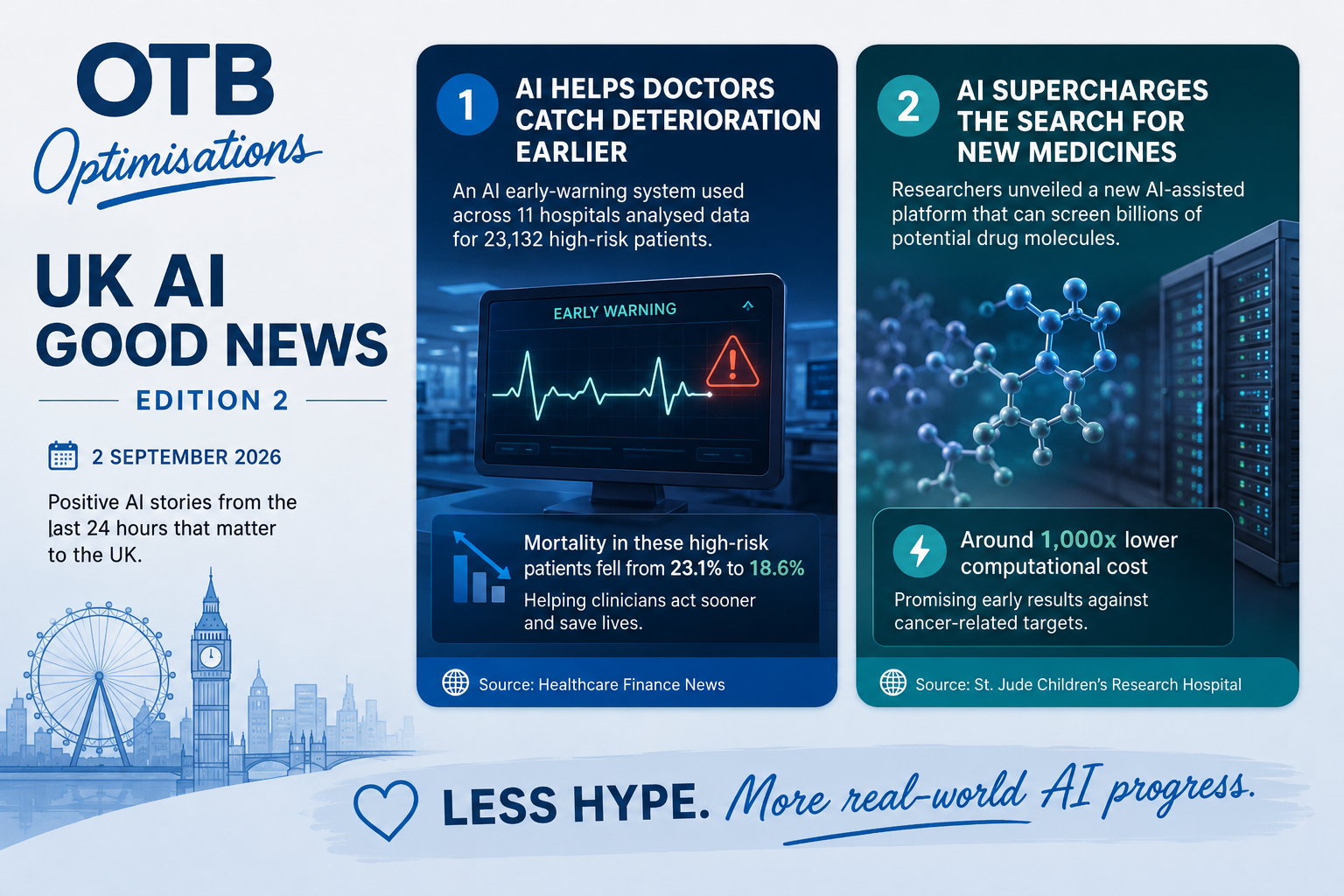
AI is already helping doctors spot deteriorating patients earlier, and new research could make the search for future medicines dramatically more efficient.
Today’s UK AI Good News looks at two very different examples of AI being used as a practical tool: one inside real hospitals, and another helping scientists search billions of potential drug molecules.
Neither is about replacing doctors or scientists. Both are about giving them better tools.
AI early-warning system linked to fewer hospital deaths
Researchers from RWJBarnabas Health and Rutgers Robert Wood Johnson Medical School evaluated an AI early-warning system across 23,132 high-risk patients in 11 hospitals.
The system continuously analyses information already collected in patients’ electronic health records, including vital signs, laboratory results, nursing assessments and age.
It recalculates a patient’s deterioration risk every 15 minutes and alerts rapid-response teams when someone enters the highest-risk category.
Following implementation, mortality among these high-risk patients fell from 23.1% to 18.6%.
Rapid-response assessments increased, while transfers into intensive care did not significantly increase.
This matters because this isn’t simply an AI performing well on a benchmark. It is AI incorporated into an actual hospital workflow, helping clinicians identify people who may be deteriorating before the signs become obvious.
The researchers stress that the AI is only part of the system. The clinical workflow and the people responding to its warnings are crucial.
AI cuts the computational cost of massive drug searches by around 1,000 times
Researchers from St. Jude Children’s Research Hospital and collaborating institutions unveiled AdaptiveFlow on 1 September, with the work published in Nature Biotechnology.
The open-source platform uses machine learning to help decide which areas of enormous chemical libraries are worth investigating in detail.
Researchers report that it can screen libraries containing billions of drug-like molecules with around a 1,000-fold reduction in computational cost compared with existing methods.
They demonstrated the system at enormous scale, screening a library containing 69 billion molecules.
More importantly, this wasn’t purely a computing demonstration. As a proof of concept, researchers used AdaptiveFlow to identify inhibitors against two cancer-related targets, PARP1 and FSP1.
This does not mean AI has produced a new cancer treatment. These are early-stage drug-discovery results. But making enormous molecular searches cheaper and more accessible could allow researchers to explore potential medicines that previously required prohibitive amounts of computing.
Sources: Nature Biotechnology paper ↗ · St. Jude Children’s Research Hospital ↗
Why this matters
These two stories illustrate something that often gets lost in the AI debate.
One system is helping clinicians notice danger sooner using information hospitals already collect. The other is allowing scientists to search an almost unimaginably large chemical space more efficiently.
Neither involves replacing doctors or scientists. They’re giving people better tools to work with.
Less hype. More real-world AI progress.