A sudden change in an older hospital patient’s attention or thinking can be more than ordinary confusion. Delirium is a serious clinical problem, and researchers in the United States are investigating whether AI could help teams recognise it earlier.
This is another international edition on a quieter day for the UK announcements covered here. We are featuring a clearly identified US research grant because the clinical problem is important, not presenting American funding as British progress or implying that the NHS has adopted the planned system.
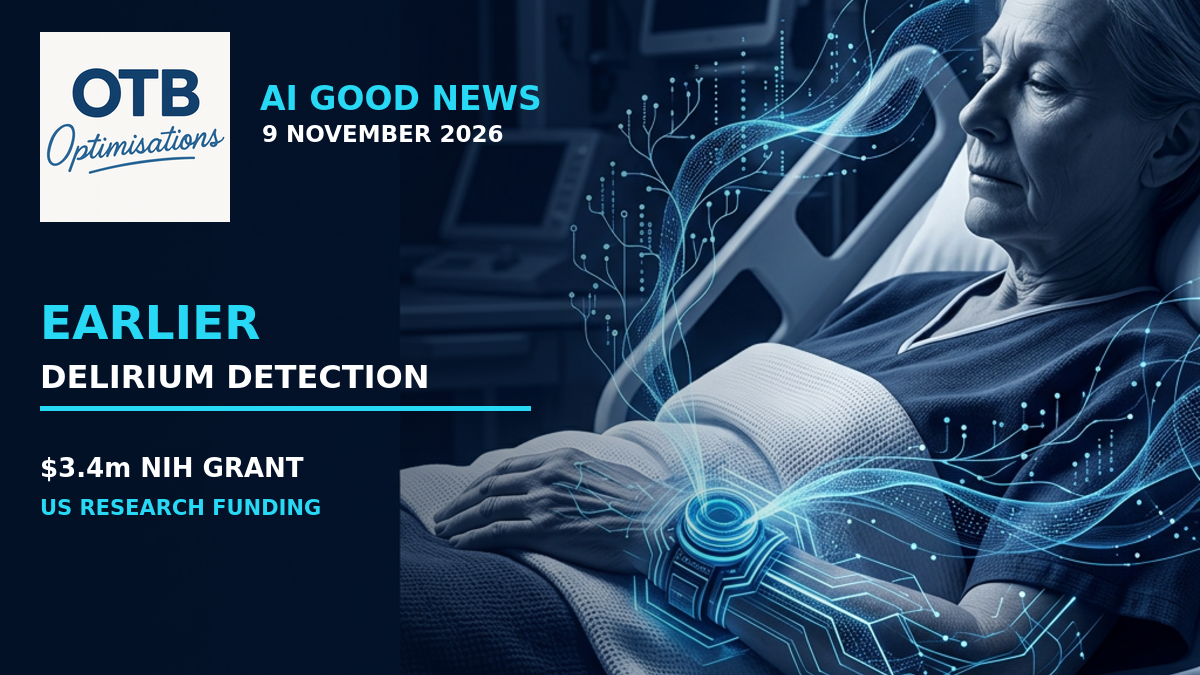
A press release published by BioSpace on 8 November 2026 reports that researchers at Northwell Health’s Feinstein Institutes for Medical Research have received a $3.4 million National Institutes of Health grant. The funding will support AI development for identifying and predicting delirium in hospital care.
Detection and Prediction Are Different Tasks
The project has two related modelling goals. One is to identify patients who already have delirium when they arrive in the emergency department. The other is to predict which admitted patients may develop it later during their hospital stay.
Those questions need different evaluation. Identifying an existing condition requires comparison with a reliable clinical assessment. Forecasting a future condition requires checking whether a risk estimate is accurate, timely and useful before that condition develops.
The planned models will use electronic health record data and continuous information from wearable devices. The team also intends to work with doctors, nurses and hospital administrators on integrating the tools into clinical workflows.
Why Older Patients Matter
Delirium can involve an acute disturbance in attention and mental abilities. It is particularly important in older hospital patients and can be associated with falls, longer stays and lasting cognitive difficulties.
It should not be treated as another name for dementia. The announcement discusses links with later cognitive problems, but this grant does not demonstrate that an AI model prevents Alzheimer’s disease or reverses dementia.
The appeal of combining records and wearable signals is that changing information may help clinicians notice patterns that are otherwise difficult to follow continuously. That is the research rationale, not proof that the proposed system can already diagnose individual patients safely.
A Grant Is the Beginning of the Evaluation
The confirmed news is the funding award. The release describes models to be built and validated using diverse patient groups. It does not provide completed clinical results showing that these new delirium models improve care.
It also refers to earlier work on predicting general patient deterioration. Evidence for a different prediction task cannot be carried over as proof that the new delirium tools work. The outcome, population and clinical response all matter.
What Useful Evidence Would Look Like
A worthwhile tool needs more than a strong accuracy score on historical data. Researchers will need to understand missed cases, false alarms, performance across patient groups and whether it works in settings beyond the data used to develop it.
There is also a practical question: what happens after a warning? A flag is only useful if staff can interpret it and respond appropriately. Too many unreliable alerts could add work rather than help, while missed warnings could offer false reassurance.
Health records and wearable measurements raise questions about privacy, data quality and unequal access to usable information. These are considerations for evaluating the planned approach, not claims that the researchers have already resolved every issue.
The Real Reason for Optimism
The project focuses on a concrete, often difficult-to-recognise problem and includes clinicians in the development process. That is a more useful starting point than a broad promise that AI will transform every hospital task.
For now, the positive development is support for careful research into earlier recognition and risk assessment. Whether that becomes better care for older patients is the next question to answer, not an outcome to assume.
Sources and Further Reading
- BioSpace: Feinstein Institutes secures $3.4m NIH grant for delirium AI research. Published 8 November 2026. Verified institutional press release carried by BioSpace, not an independent peer-reviewed evaluation. Source for the award, planned EHR and wearable models, and workflow development.
Less hype. More real-world AI progress.