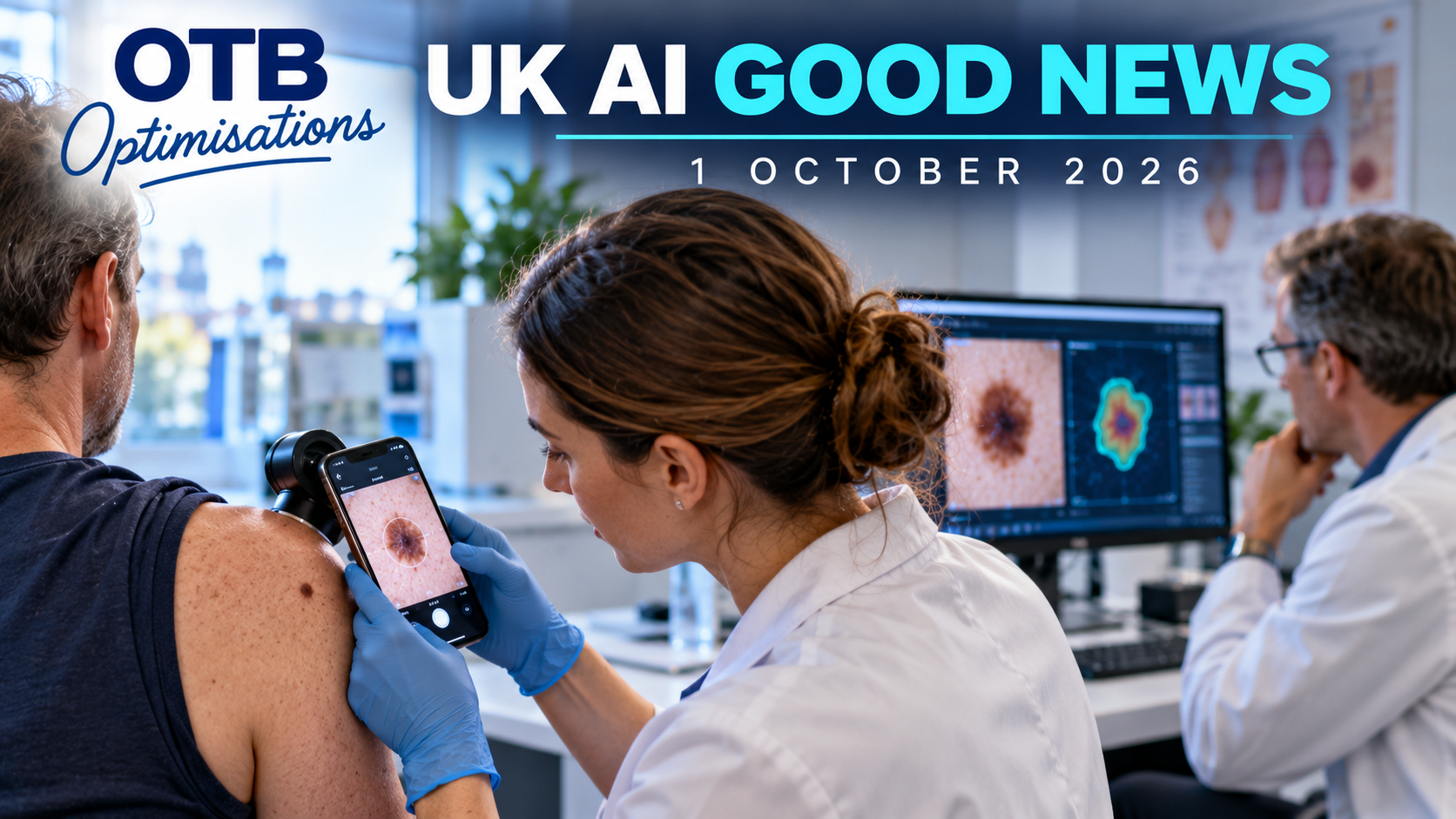
This is the sort of AI story worth looking at closely: real-world data from 8,391 patients across two UK hospitals, examining whether technology can reduce routine workload and protect scarce specialist time.
AI takes on some of the low-risk cases
The research, presented on 30 September at the European Academy of Dermatology and Venereology (EADV) Congress 2026 in Vienna, examined an autonomous AI-supported pathway for urgent suspected skin-cancer referrals.
Clinical and dermoscopic smartphone images of skin lesions were assessed by a CE-marked Class III AI medical device. After an initial validation period, the system could discharge some patients whose lesions it classified as benign without specialist review, while higher-risk cases went to a teledermatologist.
The pathway managed 8,391 patients, representing 94% of urgent suspected skin-cancer referrals across the two hospitals. That is experience from a deployed pathway, not just a laboratory test. It is also evidence from two sites, not proof of the same result across the whole NHS.
Sources: EADV: real-world study release ↗ · EADV Congress 2026 ↗
2,851 hours of specialist time
Over the 16-month study period, researchers estimated that the pathway saved 2,851 hours of clinician time compared with traditional face-to-face care. They described this as an approximate 62% gain in clinical capacity.
Using a 20-minute consultation as the benchmark, that time is equivalent to more than 8,500 additional face-to-face dermatology appointments. This is an estimate of capacity that could be released, not evidence that 8,500 extra appointments were actually delivered.
The researchers also reported routine follow-up requirements of 12%, compared with 27% for standard teledermatology. Biopsy rates were 27%, compared with 43% for conventional face-to-face care. Those comparisons describe the studied pathways; they do not on their own establish better long-term patient outcomes.
Autonomous does not mean infallible
The safety findings matter just as much as the time savings. Six false-negative cases were discharged from the pathway: five basal cell carcinomas and one melanoma in situ. These were subsequently identified through post-market surveillance. Researchers reported no adverse outcomes identified within the available follow-up, which is not the same as proving there was no risk or long-term harm.
Deployment is not the end of the process. Medical AI needs continuing monitoring, a way to identify and respond to mistakes, and clear information for patients about what to look out for. These findings do not mean a consumer app can safely assess a worrying skin lesion, or that dermatologists are no longer needed.
Source: EADV: safety monitoring, comparisons and study disclosures ↗
Separate UK research announced by the University of Bristol on 30 September reinforces that point. More than 2,300 patients, members of the public and GPs took part in a study of preferences for AI skin-cancer checks. Avoiding missed cancers was their most important consideration. Participants also wanted tools developed and tested across a wide range of skin tones, and preferred checks used by healthcare professionals rather than on their own at home.
This was a study of what people want from the technology, not an evaluation of the same two-hospital pathway.
Sources: University of Bristol: patient and GP preferences ↗ · British Journal of Cancer: preferences study ↗
Protect people's time for the work that needs their expertise
There is a useful lesson here for small businesses too. When people hear “AI automation”, the conversation often jumps to replacing jobs. A better starting point is to ask what consumes someone's time without needing all of their expertise.
That might be checking straightforward documents, copying information between systems or sorting enquiries before finding the few cases that genuinely need attention.
At OTB Optimisations, the question is not “What can AI replace?” It is “Where are we wasting valuable human time?” Then work out whether AI, automation or something simpler can give some of that time back, with checks appropriate to what could go wrong.
No AI for the sake of AI.
Less hype. More real-world AI progress.