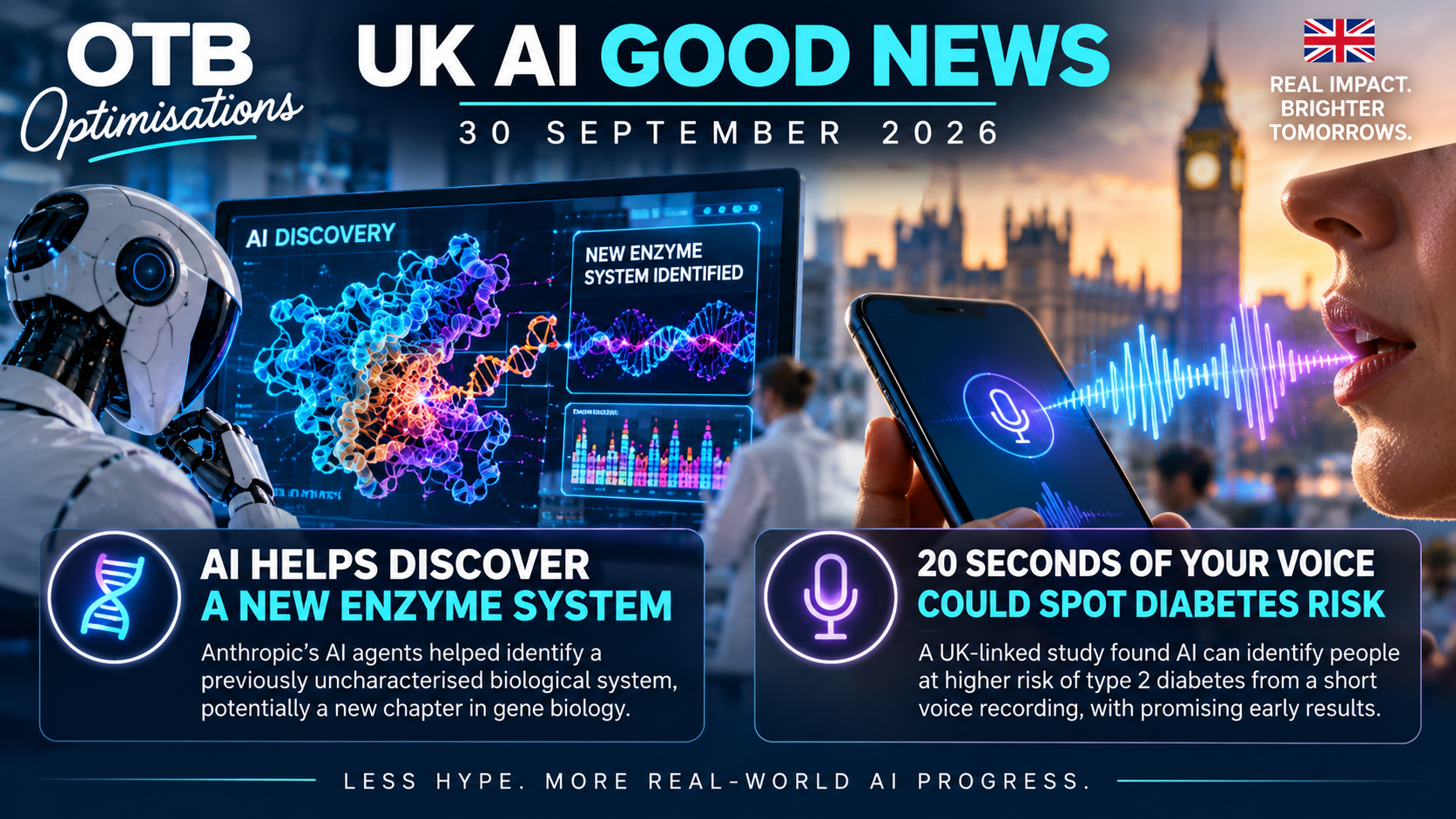
One story asks what AI can find in a vast collection of DNA. Another asks whether a short voice recording could help identify who needs a diabetes blood test. In both, the useful role for AI is to flag what a person should investigate next.
AI scientists and a closer look at new biology
We covered Anthropic's AI-assisted biology finding on 24 September and revisited it on 27 September. This is a closer look prompted by WIRED's 29 September examination, not another new discovery.
Anthropic asked Claude agents to search a large database for unusual reverse transcriptases, enzymes that copy RNA into DNA. Around 950 agents worked for about 21 hours, narrowing the search and flagging a repeating DNA pattern next to one enzyme. Human scientists then investigated that lead in the laboratory.
The researchers call the associated system ART, short for array-associated reverse transcriptases. The enzyme itself had been identified before; the reported new observation is the surrounding repeat array and its possible relationship to a previously uncharacterised biological system. WIRED spoke to independent researchers who found the approach interesting but cautioned against treating the result as a finished discovery about biological function.
ART shares some superficial features with other repeat-array systems, but nobody has established what it does. It is not a proven CRISPR-like gene-editing tool or a treatment. The research is a preprint and still needs more experimental work.
Sources: Anthropic: original research announcement ↗ · Research preprint ↗ · WIRED: independent perspectives, 29 September ↗
Could 20 seconds of speech help spot diabetes risk?
Researchers at London-based thymia and RMIT University have also studied whether AI can detect vocal patterns associated with type 2 diabetes. They trained a model on 63,283 voice samples from 21,129 people in the UK and US, then evaluated it on separate, approximately 20-second recordings from 7,319 UK adults.
For a subgroup of 801 people, the researchers also had HbA1c blood-test results. Against those results, the model flagged 82% of participants with type 2 diabetes, but its false-positive rate was 47%. Nobody it assigned to its low-risk category in that subgroup had blood results in the diabetic or prediabetic range. These results come from a selected study subgroup, not a guarantee that a low-risk voice result rules out diabetes for everyone.
Performance was weaker for some groups and people with certain other conditions. A high-risk voice result would still need a proper blood test, and a recording should not be used to diagnose diabetes or decide against clinical advice. The researchers say testing in clinical settings is the next step.
Sources: EASD meeting research release ↗ · Voice-screening research preprint ↗ · thymia: study overview ↗
Give people better leads, not automatic answers
In the biology work, AI highlighted something unusual and scientists followed it up. In the voice study, an AI risk signal might eventually help a clinician decide who should receive a blood test. Neither result removes the need for people to check the evidence and make the decisions that matter.
For businesses, the lesson is similar: use technology to search through information and surface what needs attention, then give people time to apply their judgement.
No AI for the sake of AI.
Less hype. More real-world AI progress.