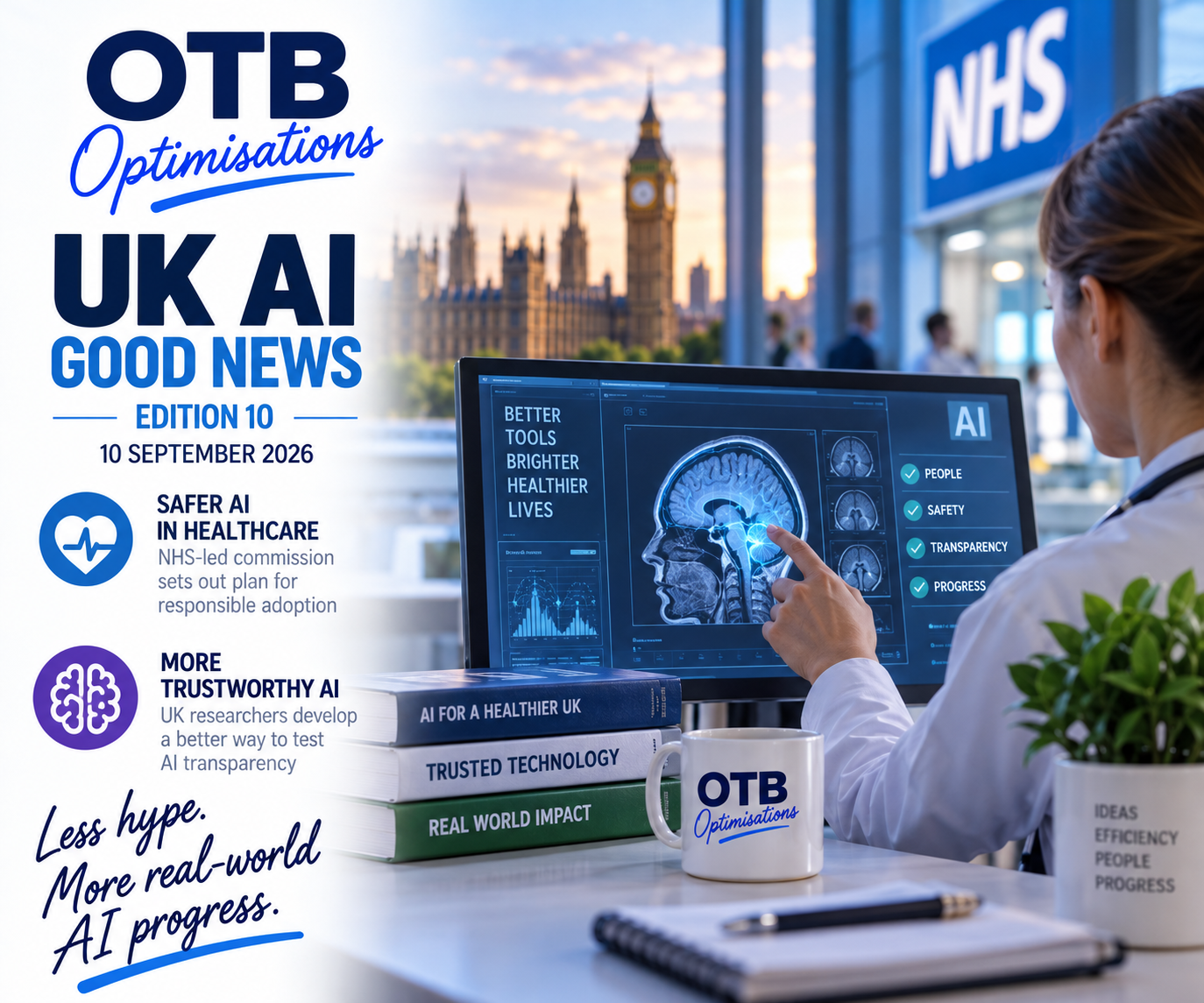
Today’s strongest AI good news is firmly UK-focused, and it tackles one of the biggest questions surrounding AI:
How do we get the benefits without compromising safety and trust?
A major independent commission led by NHS doctors has published recommendations today for how AI should be regulated in healthcare.
And there’s also new UK research looking at another important issue: whether an AI system that claims to explain its decisions is actually as transparent as it appears.
A “learner driver” approach to healthcare AI
The National Commission into the Regulation of AI in Healthcare gathered evidence from more than 12,000 people, including patients, clinicians, healthcare leaders, researchers and technology developers.
One of its most interesting recommendations is a staged approval system for new healthcare AI.
Think of it a little like L-plates for AI.
Promising AI systems could initially be introduced under close supervision and strict safeguards, allowing them to demonstrate their safety and performance in real healthcare settings before receiving fuller authorisation.
The Commission also recommends continuous monitoring of AI-enabled medical devices throughout their working lives, rather than simply approving a system once and assuming the job is finished.
Patients should also have clearer information about when AI is being used in their care and easier access to safety information about AI-enabled medical devices.
The goal is an interesting balance:
Get genuinely useful AI to patients faster, while keeping humans firmly involved and patient safety at the centre.
Source: UK Government — Independent Commission blueprint for safe AI adoption in healthcare ↗
Can we trust AI when it explains itself?
There’s another interesting UK development from King’s College London.
Researchers at King’s, working with colleagues at the Alan Turing Institute, have developed a new mathematical framework for testing whether supposedly explainable AI systems are genuinely transparent.
This matters particularly in areas such as healthcare.
An AI might appear to explain why it reached a particular conclusion, but the model could still be using hidden information that the doctor reviewing the decision cannot see.
Researchers call this information leakage.
The new framework provides ways of measuring that leakage.
When researchers tested it across several datasets, they found it could reliably detect hidden information leakage and predict how models would respond when their underlying concepts were deliberately changed.
That could eventually help developers build AI systems whose explanations are genuinely meaningful to the humans using them.
Source: Journal of Machine Learning Research — Leakage and Interpretability in Concept-Based Models ↗
Why this matters
Today’s theme is really about trust.
The best AI systems of the future won’t simply need to be clever.
If they are helping doctors make decisions about our health, we need to understand when they work, where their limitations are, who remains responsible and what happens when something goes wrong.
That might not generate the same headlines as another enormous AI model.
But it is exactly the kind of groundwork needed if AI is going to become genuinely useful in healthcare.
The goal shouldn’t be AI replacing doctors.
It should be giving doctors better tools while keeping people, safety and accountability at the centre.
Less hype. More real-world AI progress.