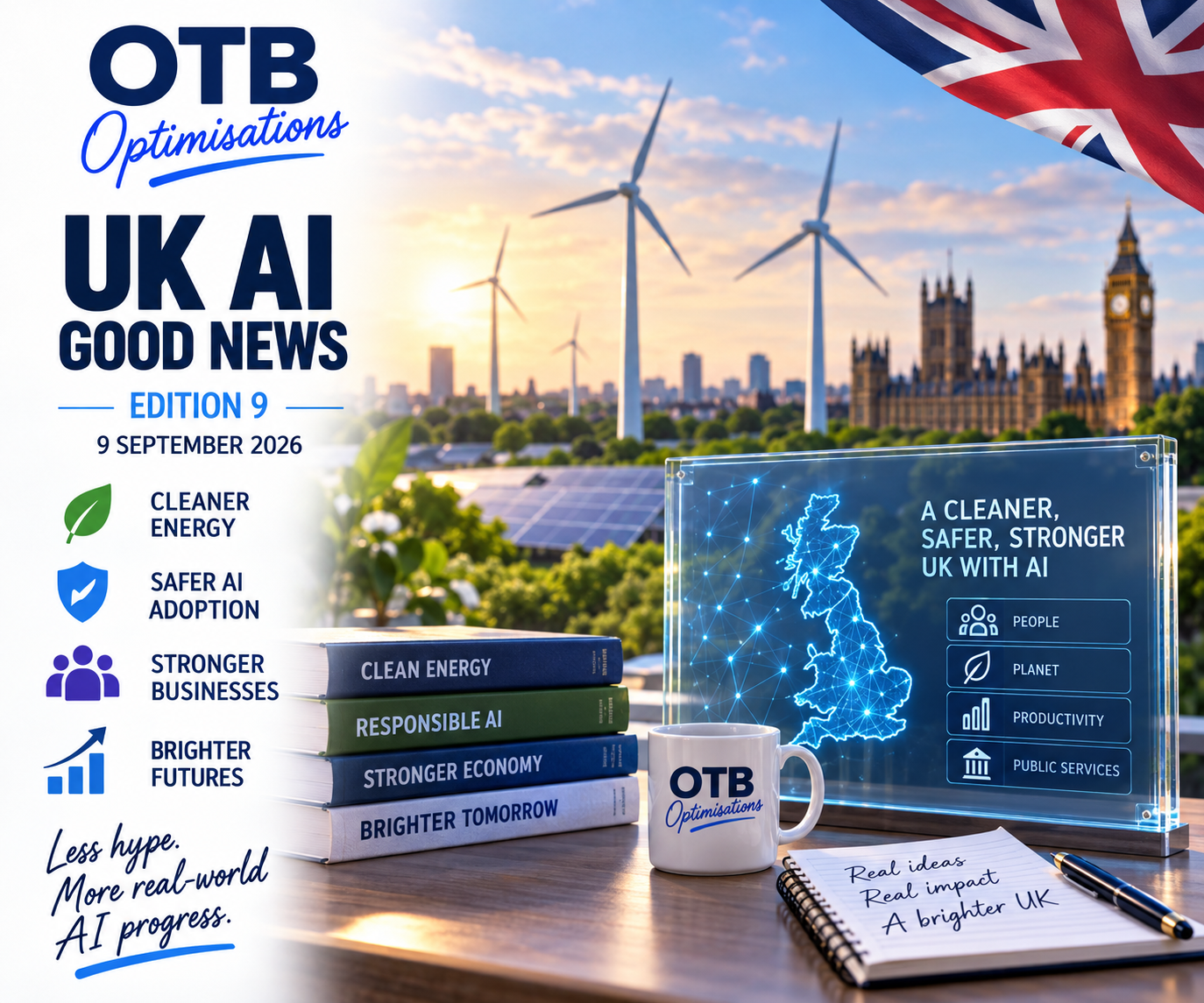
Today’s UK AI Good News is less about a spectacular new AI breakthrough and more about something arguably just as important: turning AI into something we can actually use responsibly in the real world.
Two new UK Government developments published yesterday focus on exactly that.
One looks at how AI could help Britain build a cleaner, more efficient energy system.
The other gives businesses and organisations practical guidance for managing the risks that come with adopting AI.
AI could help Britain run a smarter clean-energy system
The Department for Energy Security and Net Zero has published its new Vision for an AI-enabled clean energy system.
The aim is to explore how AI could help Britain manage an increasingly complicated energy network, with renewable generation, battery storage, electric vehicles and changing electricity demand all needing to work together.
The government is seeking evidence from industry, academia, energy-system operators and regulators about the opportunities and risks involved.
Ultimately, this work will help shape a future UK AI for Clean Energy Strategy.
This is important because AI could potentially help energy networks forecast supply and demand more accurately, optimise infrastructure and make better use of renewable energy.
But there is an important distinction.
Source: UK Government — Vision for an AI-enabled clean energy system ↗
New UK toolkit aims to make AI adoption safer
There was another development yesterday that I think is particularly interesting for businesses.
The Department for Science, Innovation and Technology has released a new AI Risk Management Toolkit.
It is designed to help people involved in designing, buying, operating or delivering AI systems understand, assess and manage the risks involved.
That includes organisations introducing commercial AI products, building their own AI systems or integrating AI into internal and customer-facing operations.
And that matters.
As businesses move beyond simply experimenting with tools such as ChatGPT and start putting AI into actual processes, somebody needs to ask:
What could go wrong?
How serious would it be?
Who is responsible?
What safeguards should we put in place?
The new toolkit gives organisations a framework for thinking through those questions.
It even includes a downloadable workbook to help teams work through AI risk management in practice.
Source: UK Government — AI Risk Management Toolkit ↗
Why this matters
These might not be the sort of AI stories that generate enormous headlines.
But they’re important.
We’re gradually moving from:
“Look what AI can do.”
to:
“How do we actually use AI properly?”
For UK businesses, that shift matters enormously.
The real opportunity isn’t simply having access to the cleverest AI model.
It’s finding the right places to use AI, connecting it properly to existing processes and making sure there are sensible safeguards around it.
That’s when AI stops being an experiment and starts becoming useful.
And that is exactly the kind of AI progress I want this series to keep highlighting.
Less hype. More real-world AI progress.