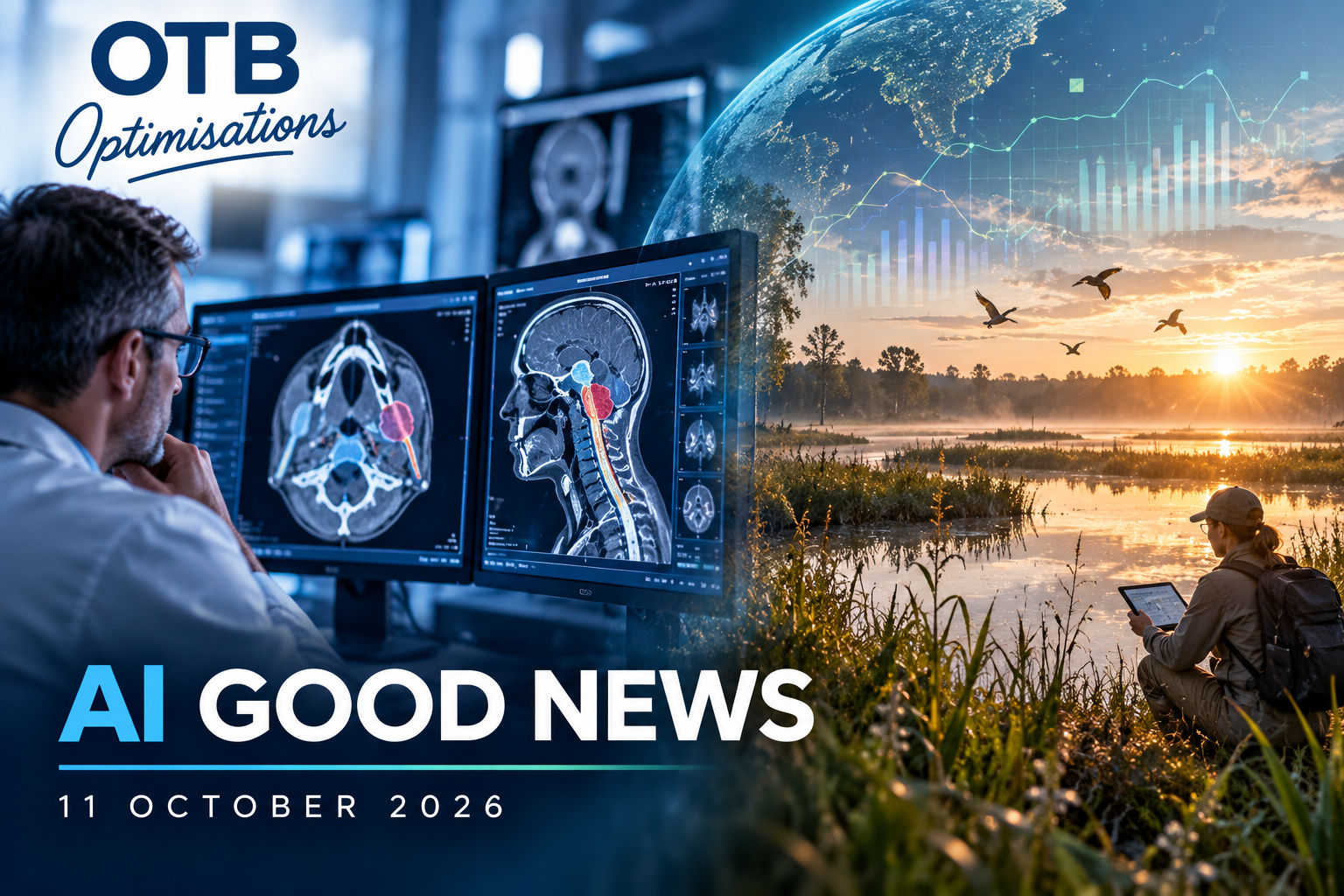
What if AI could help surgeons identify dangerous complications before operating on a cancer patient?
That’s the ambition behind new research published yesterday, involving scientists from the UK, Europe and America.
And in another development, researchers have used machine learning to create detailed estimates of how wetlands absorb and release greenhouse gases.
Two very different applications, but both demonstrate how AI is helping scientists tackle difficult problems.
🏥 1. AI could help surgeons plan complex cancer operations
Researchers, including a scientist from the University of Liverpool, have developed an experimental AI system that analyses CT scans of head and neck cancers.
The study, published in Scientific Reports on 10 October 2026, investigated a particularly serious surgical problem.
Some tumours grow around the carotid artery, one of the major blood vessels supplying the brain.
When this happens, removing the cancer can become considerably more dangerous.
Surgeons need to understand exactly where the tumour sits in relation to the artery before deciding how to proceed.
The researchers developed a system combining two AI models to identify the tumour and carotid artery in medical scans.
Using images from 100 patients, the system demonstrated promising results in identifying these structures and assessing their proximity.
The tumour-segmentation model achieved an average F1 score of 86%, while the best carotid artery segmentation method reached 79% accuracy.
Why is this important?
In the future, technology like this could help surgical teams assess complicated cases more consistently and potentially reduce the time spent manually examining scans.
But there is an important distinction.
This is a research prototype, not a clinically proven surgical planning tool.
The researchers demonstrated its technical capabilities using existing medical images. They have not yet shown that it improves surgical outcomes or reduces complications.
Nevertheless, it’s a promising example of AI being developed to support medical expertise rather than replace it.
Source: Scientific Reports: Automated detection of carotid artery encasement on CT scans using an AI-driven approach ↗ — published 10 October 2026.
🌍 2. AI helps scientists understand how wetlands affect climate change
Wetlands are extraordinary natural environments.
They provide habitats for wildlife, help manage flooding and store enormous quantities of carbon.
But there’s a complication.
While wetlands absorb carbon dioxide, they can also release methane, a powerful greenhouse gas.
Understanding the balance is essential for accurately measuring their impact on climate change.
In research published on 10 October 2026, scientists used machine learning to investigate carbon dioxide and methane exchanges across wetlands in the southeastern United States.
The team combined observations from 24 wetland monitoring sites with information about vegetation, soil, water and climate.
They then used several machine-learning models to estimate how greenhouse gas exchanges varied across the region between 2000 and 2020.
The models identified geographical patterns, including areas of elevated methane emissions along the North Carolina coast.
Why does this matter?
Understanding where wetlands absorb carbon and where they release greenhouse gases can help researchers develop better climate assessments.
Eventually, that information could support more informed conservation and land-management decisions.
But the models weren’t equally accurate for everything.
Predictions of methane emissions were less reliable than some of the carbon dioxide measurements, demonstrating that further research is needed.
The demonstrated result is improved regional modelling, not a proven reduction in emissions.
And that’s still useful progress.
Source: Ecological Processes: Ensemble machine learning-based scaling up of wetland carbon dynamics across the Southeastern U.S. ↗ — published 10 October 2026.
The bigger picture
What connects cancer surgery and wetland conservation?
Information.
In healthcare, doctors need to understand complicated relationships between tumours and surrounding structures.
In environmental science, researchers need to understand complicated relationships between soil, vegetation, water and greenhouse gases.
Both problems involve enormous amounts of information.
And that’s where AI can help.
It can identify patterns, analyse complex data and give experts additional information to work with.
But today’s research also demonstrates something important.
A promising AI result is not the same as a proven real-world benefit.
The medical system still needs clinical validation.
The environmental models still contain uncertainty.
Both are useful steps towards solving important problems, but neither represents a finished solution.
And that’s exactly how progress should be measured.
Less hype. More real-world AI progress.
Editorial note: This was a relatively quiet weekend for major UK AI announcements. Both featured studies carry a publication date of 10 October 2026. Exact publication times were unavailable, so their placement within the precise 24-hour window cannot be guaranteed. Rather than recycle older headlines, today’s bulletin focuses on two newly published research papers.