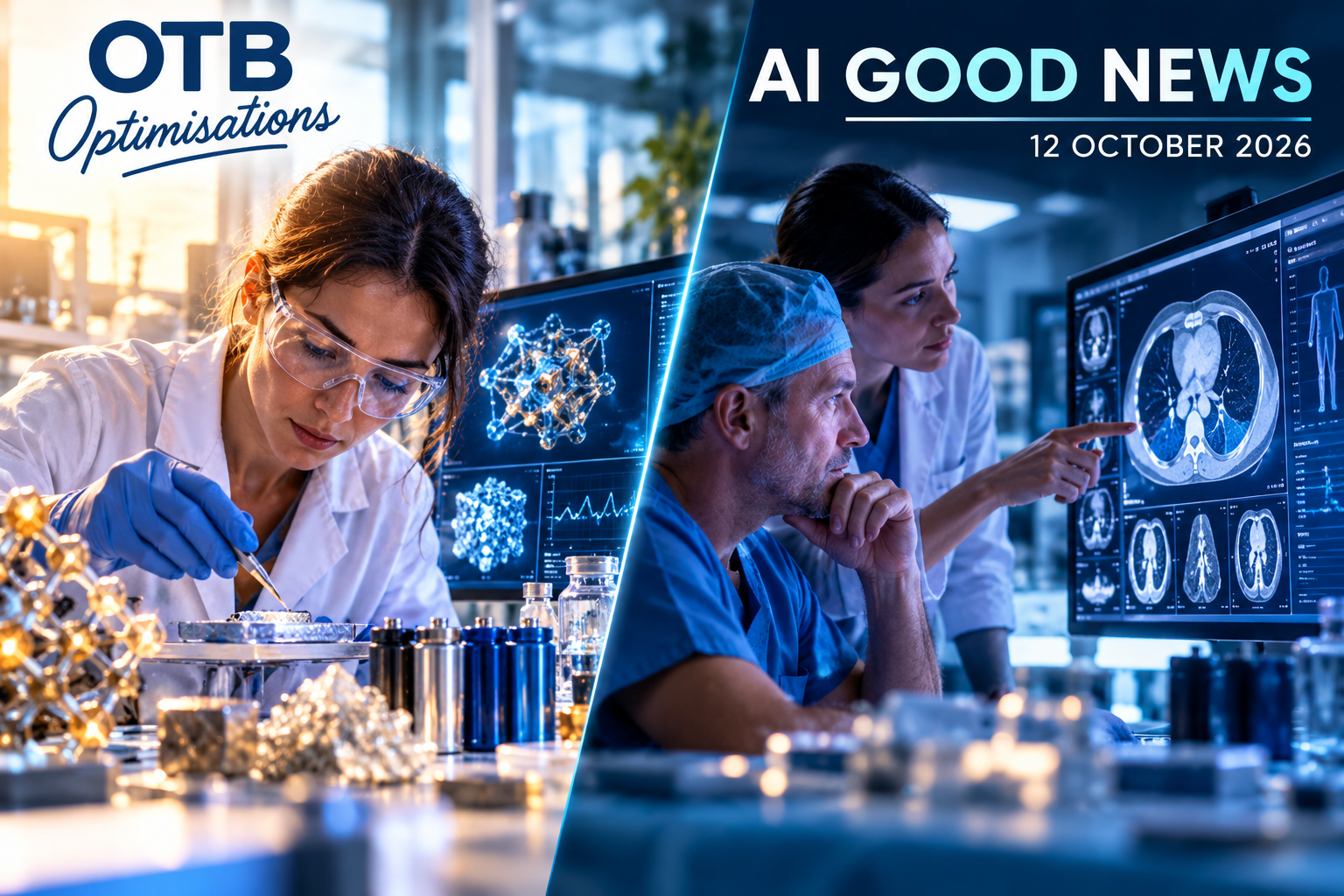
What if AI could help scientists develop better batteries faster, while also helping surgeons predict which patients are most likely to experience complications?
Two developments reported on 11 October offer an interesting glimpse of that future.
One involves a British university spinout attracting millions in investment to accelerate materials discovery. The other is a newly published medical study showing how AI can help researchers predict surgical risks.
It’s been a relatively quiet 24 hours for major AI breakthroughs, so today’s bulletin focuses on two developments rather than filling the article with older announcements.
Neither has yet demonstrated its hoped-for real-world benefits, but both are worth watching.
🇬🇧 1. Liverpool AI company raises £4 million to accelerate scientific discovery
A new British company is hoping to change how scientists discover and develop materials.
Matter Machine, a spinout from the University of Liverpool, has secured £4 million in investment to develop AI-powered materials discovery technology.
The company is building on research led by Professor Matt Rosseinsky, with former Oxford Nanopore chief executive Gordon Sanghera taking charge of the business.
But why does materials discovery matter?
Almost everything around us depends on materials science.
Batteries, electronics, manufacturing equipment and technologies supporting renewable energy all rely on materials with particular properties.
Finding better ones can involve enormous amounts of experimentation.
Scientists might investigate thousands of possible chemical combinations before identifying something useful.
AI could help narrow down those possibilities much faster.
By analysing existing scientific knowledge and predicting promising combinations, AI could help researchers decide which experiments are worth pursuing.
The potential applications include better battery materials, improved industrial catalysts and more efficient manufacturing.
Why this matters for Britain
This is an example of British university research attracting private investment to develop practical technology.
The company is based at Liverpool’s Materials Innovation Factory, which already combines advanced laboratory equipment with expertise in automated materials discovery.
Importantly, the £4 million is investment in developing and commercialising the technology.
It is not evidence that Matter Machine has already delivered a commercially successful new battery or material.
Nevertheless, it’s a positive step towards translating British AI research into useful industrial applications.
Source: Business Matters: Liverpool AI materials spin-out Matter Machine raises £4m ↗ — 11 October 2026. Background: University of Liverpool: Materials Innovation Factory facilities and automated discovery ↗.
🏥 2. AI helps researchers predict complications before cancer surgery
Meanwhile, scientists in China have developed AI models designed to predict how patients might recover after operations to remove rare tumours.
The research, published in Scientific Reports on 11 October 2026, involved medical records from 726 patients treated at two hospitals.
The patients had thymic epithelial tumours, which develop in the chest, between the lungs.
Although these tumours are relatively uncommon, surgery can be complicated, and recovery varies considerably between patients.
Some recover quickly.
Others experience complications, significant pain or longer hospital stays.
Researchers wanted to investigate whether AI could help predict these outcomes before an operation.
They developed models using information available before surgery, including patient characteristics and clinical measurements.
The researchers tested their models against patient records from a second hospital that had not been used to develop them.
The results were encouraging.
The models showed a useful, although imperfect, ability to distinguish patients at higher risk of complications or prolonged hospital stays.
The model predicting postoperative pain performed less reliably.
Why this matters
Imagine a surgeon being able to identify patients who might need additional monitoring or support after an operation.
That information could eventually help hospitals prepare resources, plan recovery care and discuss risks with patients.
The research also used techniques that help explain which factors influenced individual predictions.
That’s particularly important in healthcare, where clinicians need to understand and evaluate AI recommendations.
However, these models were tested retrospectively using existing patient records.
They have not yet demonstrated that using AI improves recovery, reduces complications or shortens hospital stays.
Further testing with patients in real clinical settings will be needed.
Still, it’s another example of researchers developing AI to support medical decision-making.
Source: Scientific Reports: Development and validation of machine learning models for preoperative prediction of perioperative outcomes in patients with thymic epithelial tumors ↗ — published 11 October 2026.
The bigger picture
What connects discovering new materials and predicting surgical complications?
Both involve complicated decisions.
A materials scientist needs to identify which chemical combinations are worth testing.
A surgeon needs to understand which factors might influence a patient’s recovery.
In both situations, AI can analyse large amounts of information and identify patterns that might otherwise be difficult to recognise.
But there’s an important lesson here.
AI’s potential is not the same as AI’s proven impact.
Liverpool’s new company has secured investment to develop its technology.
The medical researchers have demonstrated predictive performance using historical patient data.
Neither has yet established the practical outcomes they ultimately hope to achieve.
That’s why careful testing matters.
The real value of AI isn’t simply that it can make predictions.
It’s whether those predictions help people make better decisions.
And that is where the most interesting progress is happening.
Less hype. More real-world AI progress.