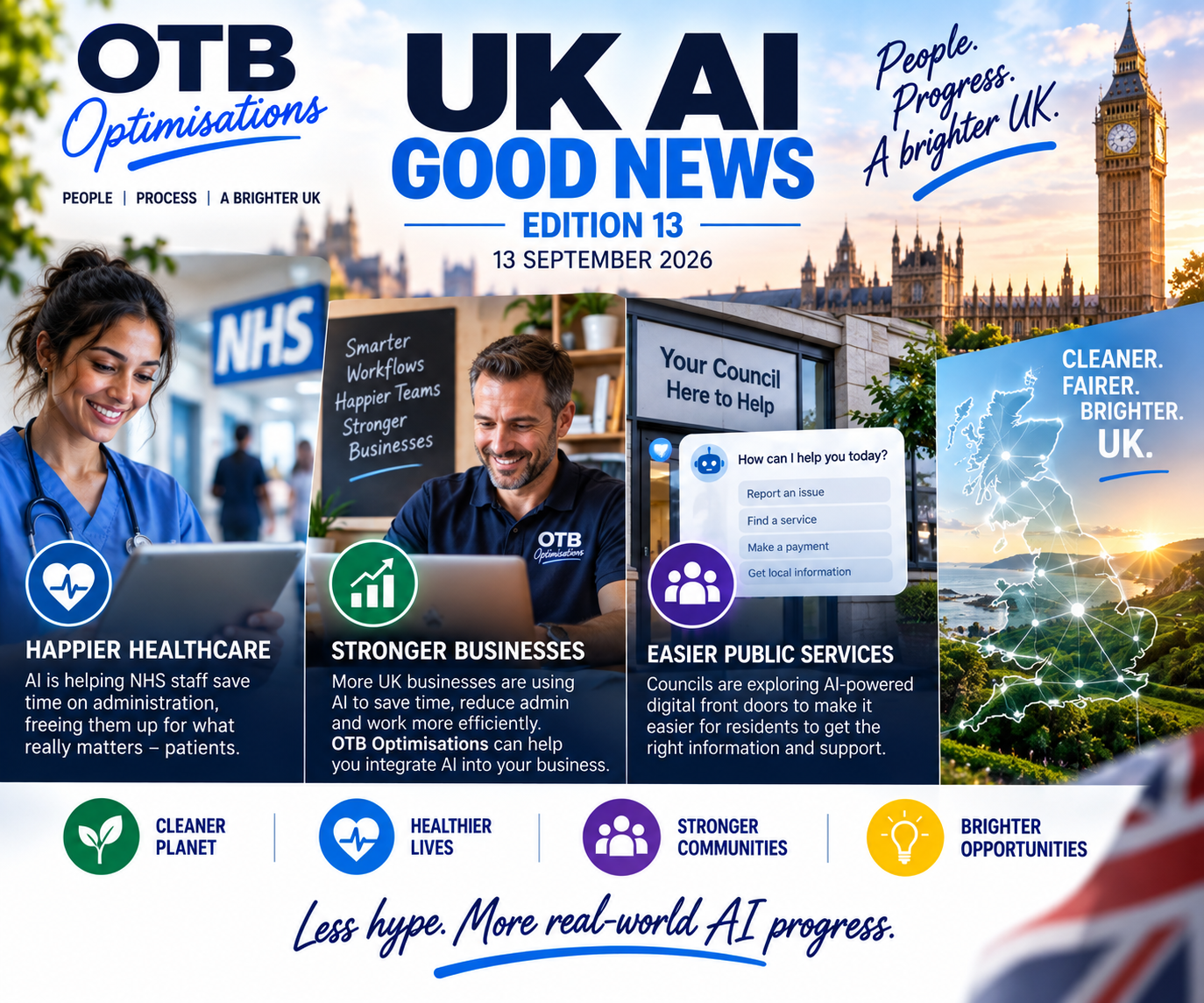
AI progress isn’t always a huge scientific breakthrough.
Sometimes it’s an NHS worker getting 40 minutes back in their day, a small business getting work done faster, or a public service becoming easier to use.
So today we’re looking beyond the big headlines at some of the practical ways AI is starting to make a difference across the UK.
Giving NHS staff more time for patients
One of the clearest potential benefits of AI in healthcare might actually be surprisingly simple: giving NHS staff some of their time back.
A major NHS trial involving more than 30,000 staff across 90 organisations tested AI tools designed to help with everyday administrative work.
According to NHS England, participants reported saving an average of 43 minutes per person per day.
That can mean less time spent drafting documents, summarising information and dealing with repetitive administration, and potentially more time available for work that actually requires a person.
Following the trial, access is being expanded to hundreds of thousands of NHS staff.
This is exactly the sort of AI progress that’s easy to overlook. Saving less than an hour might not sound revolutionary, but multiply it across a workforce as large as the NHS and the potential impact becomes enormous.
Source: NHS England — AI tools helping free up staff time ↗
AI is becoming a practical tool for UK businesses
There’s another interesting shift happening away from hospitals and laboratories.
Ordinary British businesses are increasingly using AI.
ONS data shows adoption among UK businesses with 10 or more employees has risen sharply since 2023.
And it isn’t necessarily businesses building sophisticated AI systems. They’re using existing AI to help with everyday jobs such as researching information, producing summaries, drafting correspondence and reports, analysing information and speeding up repetitive work.
For a small company, that’s potentially significant.
You don’t need an AI department or a huge technology budget. If AI can remove a few repetitive tasks each week, organise information, reduce paperwork or save somebody an hour of administration, that’s already a genuine productivity improvement.
And for small businesses where one person often does several different jobs, those small savings can add up very quickly.
Could AI help your business?
This is exactly the sort of thing we help businesses with at OTB Optimisations.
If you’re wondering where AI could fit into your own business, we can look at the way you currently work, identify repetitive or time-consuming processes and help integrate practical AI solutions that make sense for your business.
That might mean reducing paperwork, automating repetitive administration, improving how information flows through the business or building a completely new tool around the way your company works.
No AI for the sake of AI.
The aim is simple: save time, reduce unnecessary admin and help your business work better.
Explore: Visit OTB Optimisations →
Source: Office for National Statistics — Artificial intelligence in UK businesses ↗
Could AI make dealing with councils easier?
Another less glamorous but potentially very useful application is local government.
Councils are exploring AI-powered “digital front doors” designed to make it easier for residents to find the right service and information.
Imagine asking your council a normal question rather than trying to work out which department, webpage or form you need.
AI could potentially answer straightforward enquiries, help people navigate services, provide better language and accessibility support and direct complicated cases to the right human member of staff.
Done properly, that could improve the experience for residents while freeing council employees from repeatedly answering simple enquiries.
Source: Local Government Association — Digital Front Door ↗
Healthcare AI needs to be safe as well as clever
As more AI enters healthcare, the UK is also tackling a less exciting but extremely important question:
Who is responsible when medical AI is being used?
Work around the regulation of healthcare AI is increasingly focusing on monitoring systems throughout their working life, rather than assuming that passing an initial approval process is enough.
That’s important because healthcare AI operates in the real world, with different hospitals, patients, clinicians and circumstances.
For AI to become genuinely useful in the NHS, people need to trust it.
That means testing it properly, monitoring how it performs and making sure human responsibility doesn’t disappear simply because an algorithm is involved.
Small improvements can become big ones
This is probably one of the most interesting things about where AI is heading.
We understandably hear about the spectacular stuff: new medicines, scientific discoveries, robots and increasingly powerful AI models.
But there is another AI revolution happening underneath it.
43 minutes saved.
A small business getting its paperwork done faster.
Someone finding the council service they need without searching through ten webpages.
A clinician getting better information while remaining responsible for the decision.
Individually, these might sound like small improvements.
Across millions of people, thousands of businesses and hundreds of public organisations, they could become something much bigger.
And that’s exactly the kind of progress we’ll continue looking for.
Less hype. More real-world AI progress.