What if AI could help more people get potentially sight-saving treatment, while giving scientists new clues about why some cancers resist the immune system?
Two important research developments reported on 13 October show how AI is helping tackle these challenges.
1. UK-linked AI eye screening trial produces encouraging real-world results
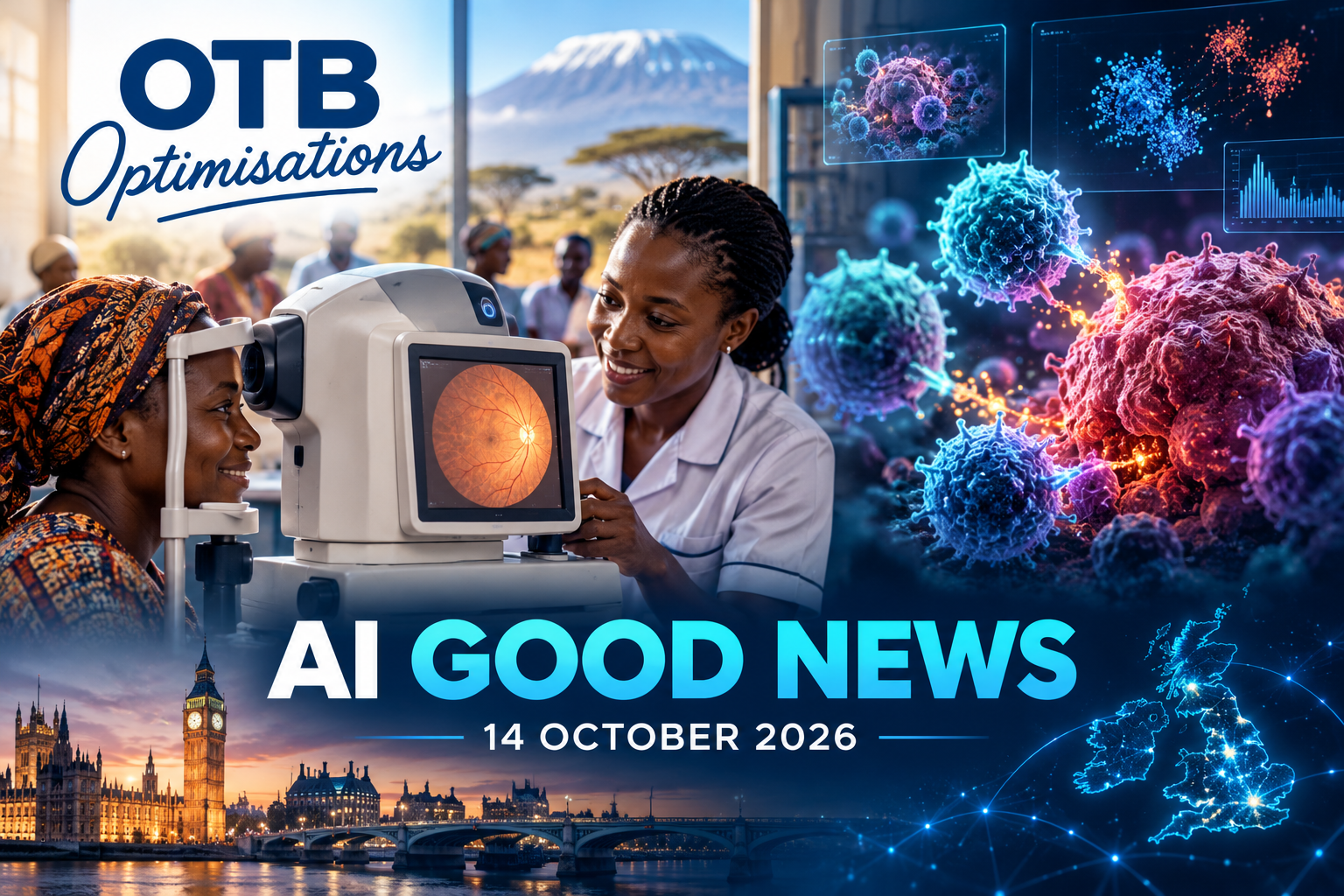
Researchers from the London School of Hygiene & Tropical Medicine and Tanzania’s Kilimanjaro Christian Medical Centre have reported encouraging results from a trial involving 2,378 people with diabetes.
The study compared traditional diabetic eye screening with a pathway using AI to analyse retinal images and provide immediate results.
Among patients who needed specialist care:
- 35.9% in the AI-supported group attended a specialist appointment within eight weeks.
- 18.2% in the conventional screening group attended within the same period.
That’s almost twice the attendance rate.
Patients attending specialist care also did so considerably sooner.
Why does this matter?
Diabetic retinopathy can damage eyesight, and timely assessment and treatment are important for preventing avoidable sight loss.
The AI-supported pathway gave patients their results immediately, allowing healthcare workers to explain the findings face to face.
Importantly, the improvement reflects the complete screening and counselling pathway, not necessarily the AI software alone.
What’s proven: The randomised trial demonstrated improved specialist appointment attendance.
What’s not yet proven: That the intervention directly reduced blindness.
Sources: LSHTM International Centre for Eye Health: People with diabetic retinopathy nearly twice as likely to reach follow-up with AI-enabled screening ↗ — 13 October 2026. The Lancet Global Health: Artificial intelligence-supported diabetic retinopathy screening in Tanzania: a randomised controlled trial ↗.
2. AI uncovers clues about why immune cells struggle to reach cancer
Meanwhile, researchers at the University of Texas MD Anderson Cancer Center have developed an AI tool called SPACER.
It investigates how immune cells move through tissues and why they gather in certain locations.
This matters because some cancers appear to prevent immune cells from reaching and attacking tumours effectively.
The research identified molecular signals associated with attracting immune cells and suggested that proteins called mucins may help form barriers that keep certain immune cells away.
The researchers analysed 37 datasets involving different tissues and tumour types.
Their AI approach performed substantially better than comparison methods at identifying biologically meaningful signals in benchmark tasks.
The findings could help scientists identify future targets for cancer treatments.
What’s proven: The AI tool identified useful biological patterns and generated research findings.
What’s not yet proven: That those findings lead to a new effective cancer treatment.
Sources: UT MD Anderson: AI tool reveals what attracts immune cells to tumors and what keeps them away ↗ — 13 October 2026. Nature Biomedical Engineering: SPACER research abstract and study details ↗.
Why today’s news matters
These stories show two different ways AI can contribute to healthcare.
In Tanzania, an AI-supported process has already improved an important patient-care outcome: attendance at specialist appointments.
In cancer research, AI is helping scientists investigate biological processes that are difficult to understand.
One is a demonstrated real-world improvement. The other is an early scientific discovery.
Both matter, provided we distinguish evidence from expectation.
Less hype. More real-world AI progress.