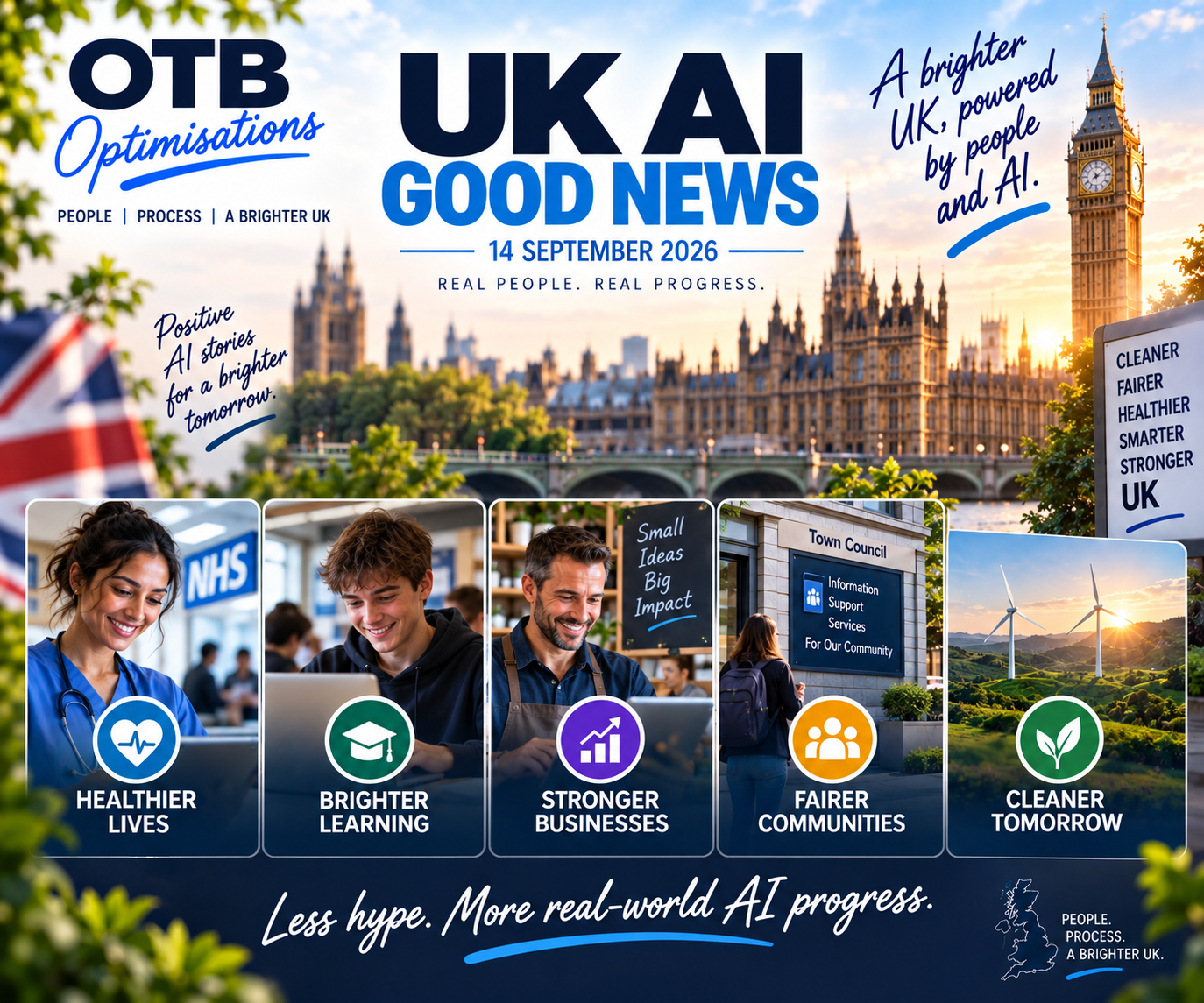
Today’s UK AI Good News is a good example of why it is worth looking beyond the giant breakthroughs.
Over the last 24 hours, there have been useful developments involving NHS staff, young people looking for work, and people struggling financially.
These are not science-fiction stories. They are examples of AI being applied to everyday problems.
1. AI medical assistants are already helping cut healthcare admin
A fresh healthcare story caught my attention because the technology is already accessible to large numbers of NHS professionals.
Tandem Health has developed an AI medical assistant that can listen during consultations and help produce clinical notes, patient summaries, documentation and coding.
The company says clinicians using its technology report spending 29% less time on administrative work.
In the UK, a partnership with Accurx has made the technology accessible to hundreds of thousands of NHS practitioners.
The latest development is that Tandem has secured a new $100 million funding round, led by the Scaleup Europe Fund, which is intended to support further expansion across European healthcare.
The potentially important part here is not the investment itself.
It is what the technology is trying to achieve: doctors spending less time typing and more time concentrating on patients.
Source: Sky News — EU venture fund backs AI medical assistant Tandem Health ↗
2. Young people in the North West are learning how to work with AI
In Preston, a UK government-backed pilot is teaching young people who are out of education, employment or training how to use AI in the workplace.
The three-week programme teaches participants how AI tools are built, how businesses use them and how to use the technology responsibly.
Up to 70 young people are taking part, with companies including JD Sports, Heinz and Agilysys offering AI-related apprenticeship opportunities after the programme.
Fresh reporting from the programme includes participants saying the course has improved their understanding of AI and helped them see the technology as something they can work alongside rather than simply compete against.
That feels particularly important.
There is a lot of understandable anxiety about what AI could mean for entry-level jobs. Giving young people practical AI skills could help make sure they are able to participate in the changing workplace rather than being left behind.
Source: The Guardian — AI bootcamps aimed at addressing UK youth unemployment ↗
3. Welsh AI project aims to make financial difficulty less stressful
Here is exactly the kind of smaller UK story I want to include more often.
South Wales fintech IE Hub is working with Mega AI on a system called ELLIE, designed to make affordability conversations between people and creditors easier.
At the moment, somebody experiencing financial difficulty may have to repeatedly explain their income, spending and circumstances to multiple organisations.
The planned system combines conversational AI with IE Hub’s existing affordability platform so customers can potentially provide their circumstances once and choose which creditors receive the information.
It is also designed to identify signs that somebody may be vulnerable and direct them towards specialist help, while keeping human support available when required.
For creditors, the aim is also to reduce the amount of staff time spent on routine affordability assessments so people can concentrate on cases requiring more human support.
Source: Business News Wales — IE Hub and Mega AI launch ELLIE ↗
What does this mean for ordinary UK businesses?
There is a common thread running through all three stories.
AI does not necessarily need to replace an entire job or transform an industry to be useful.
It can:
- reduce repetitive administration
- organise information
- help people find answers faster
- support staff dealing with large workloads
- give people more time for the work that genuinely needs a human
That is also exactly the kind of opportunity we look for at OTB Optimisations.
If you run a business and suspect there are repetitive processes, paperwork or administrative jobs that could be made easier with AI, we can look at how you currently work and identify practical ways to improve it.
No AI for the sake of AI.
Just technology that helps people and businesses work better.
Explore: Visit OTB Optimisations →
Less hype. More real-world AI progress.