What if artificial intelligence could help scientists understand cancer without needing to carry out every expensive laboratory test?
That’s one of the exciting possibilities being explored by British researchers, following a new funding announcement on 15 October.
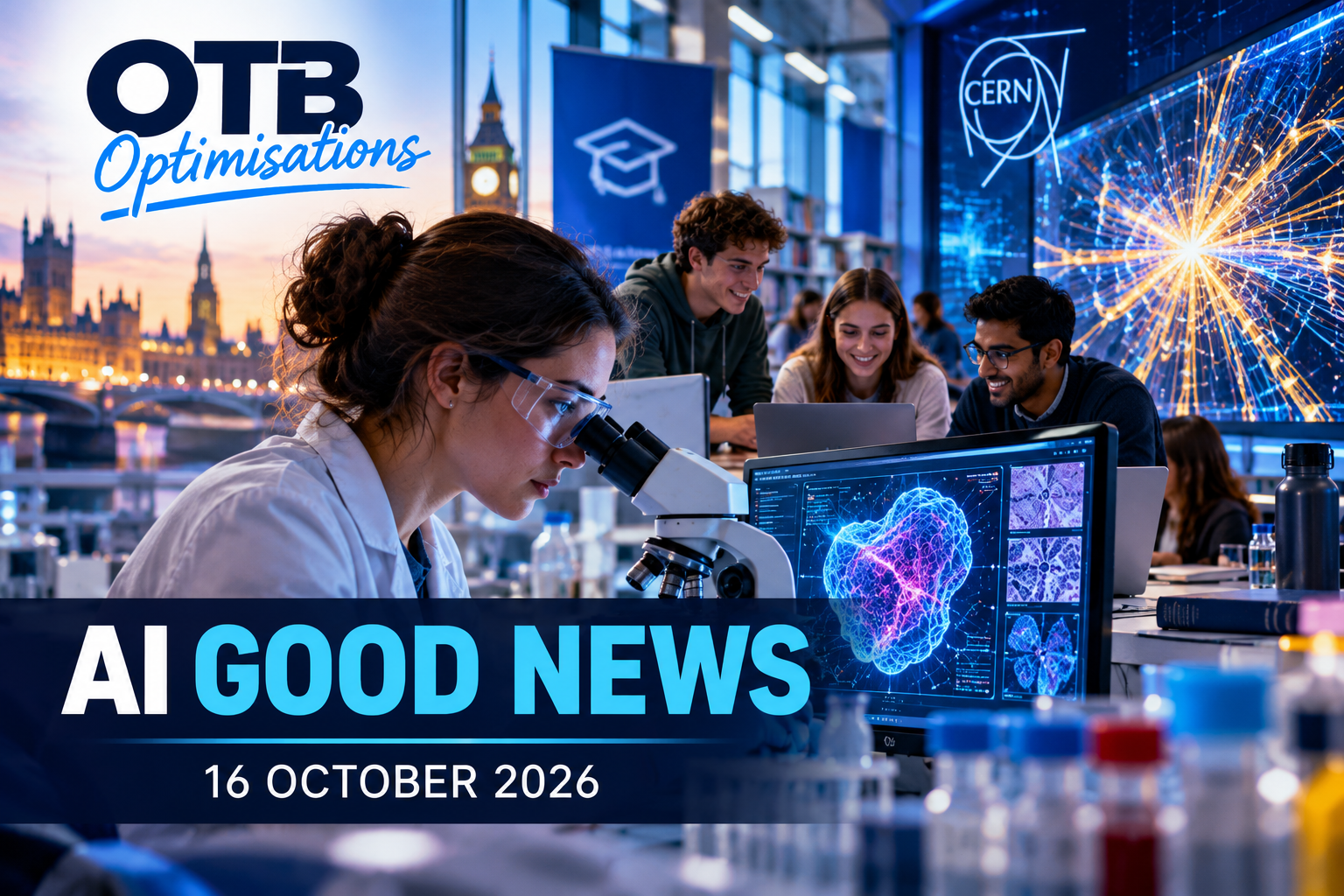
And that’s not all. Students in Leicester are receiving practical AI training, while scientists at CERN are preparing to use artificial intelligence to investigate some of the universe’s biggest mysteries.
Here are three encouraging developments worth knowing about.
🧬 1. British Researchers Explore AI Digital Twins of Human Tissue
Researchers at King’s College London, Queen Mary University of London and NHS partners have secured Innovate UK funding to investigate something remarkable: AI-generated digital twins of human tissue.
The aim is to develop models that can predict detailed biological information from existing tissue samples.
Why does this matter?
Understanding diseases such as cancer often requires expensive and time-consuming laboratory tests.
If researchers can develop reliable AI models capable of predicting some of that information, it could eventually help scientists investigate diseases and potential treatments more efficiently.
The project will also explore ways for AI to learn from information held across different organisations without requiring all the underlying data to be brought together.
The reality: This is an early-stage feasibility project. The funding is confirmed, but the technology has not yet been demonstrated to replace molecular tests or improve patient outcomes.
It’s an exciting direction for British medical research.
Source: King’s College London: PharosAI wins funding to develop AI models that could create ‘digital twins’ of human tissue ↗ — 15 October 2026.
🎓 2. University of Leicester Helps Students Develop Practical AI Skills
The University of Leicester has announced a programme designed to help students use artificial intelligence effectively and responsibly.
Students have been given access to Microsoft 365 Copilot, with practical workshops taking place during October and November.
The sessions explore everyday uses of AI, including studying, budgeting, planning and problem-solving.
The university has also introduced an AI-powered assistant to help students find information about university services.
Why is this positive?
Because AI literacy is becoming an increasingly important skill in the workplace.
Giving students opportunities to understand the technology, recognise its limitations and use it responsibly could help prepare them for their future careers.
The reality: The university has introduced access and training. Improvements in educational outcomes or employability have not yet been demonstrated.
Source: University of Leicester: Microsoft gives University of Leicester students practical training in AI ↗ — 15 October 2026.
🔬 3. CERN Plans to Use AI to Explore Particle Physics
Scientists at CERN, home of the Large Hadron Collider, have announced plans to collaborate with European AI company Mistral.
Their ambition is to develop a large AI model trained on billions of simulated particle collisions.
Why is that important?
Particle physics produces enormous amounts of complex information.
AI could potentially help scientists reconstruct collisions, identify particles and recognise unusual patterns that deserve further investigation.
The techniques developed could also have applications in other scientific disciplines.
The reality: This is a newly announced collaboration, not a completed scientific breakthrough. The proposed AI model has not yet demonstrated the discovery of new particles.
Source: CERN: CERN and Mistral join forces to accelerate AI for science ↗ — 15 October 2026.
💡 The Bigger Picture
Today’s developments highlight three important areas where artificial intelligence could make a positive difference.
In healthcare, researchers are investigating ways to make existing medical information more useful.
In education, students are developing practical skills that could help them in their future careers.
And in science, researchers are exploring new ways to understand incredibly complex information.
Not every announcement represents an immediate breakthrough.
But meaningful progress often begins with research, collaboration and giving people the tools to solve difficult problems.
That’s the kind of AI development worth following.
Less hype. More real-world AI progress.