
Today’s strongest positive AI developments are both UK-based, and one comes with a particularly striking productivity result.
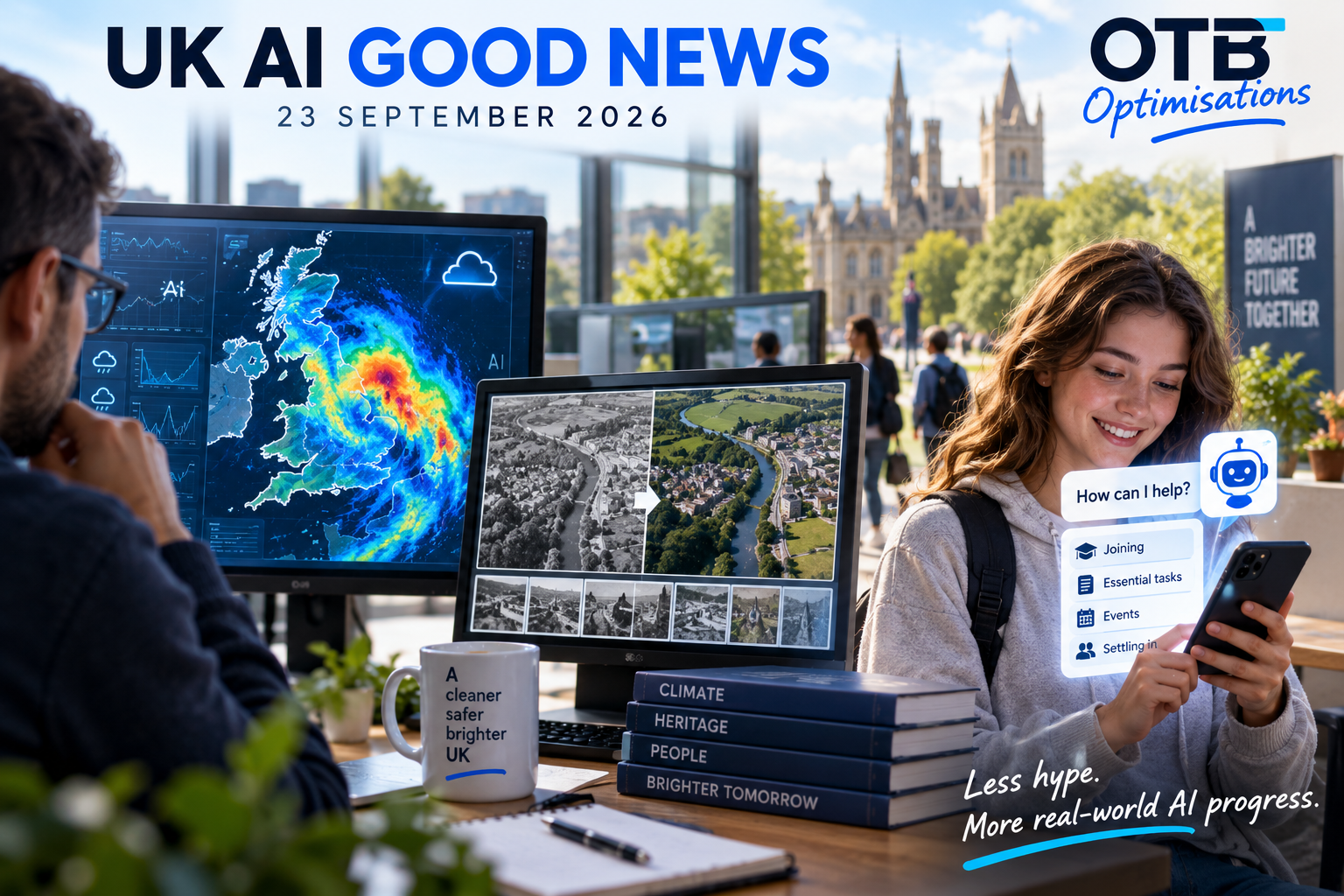
Researchers in Edinburgh are using AI to make climate modelling dramatically less computationally demanding. The same facility has also demonstrated an automated system that could turn roughly a year’s worth of manual archive work into about a week.
Making climate modelling more efficient
At the EPCC, researchers working on the EPSRC-funded CONTINENTS project are exploring whether AI can make climate and weather modelling considerably more sustainable.
Traditional climate simulations require huge amounts of computing power.
The researchers are using AI weather models such as the European Centre for Medium-Range Weather Forecasts’ AIFS, which can emulate traditional simulations using a fraction of the computing resources. At Edinburgh, inference can run on a single EIDF GPU.
The UK team is now fine-tuning the technology specifically for extreme rainfall events in Britain, using Met Office weather-warning data while measuring the energy consumed throughout the AI lifecycle.
That’s important because the aim isn’t simply to make weather AI more powerful.
It’s to make useful climate modelling less computationally and energy intensive too.
This is active research rather than a finished forecasting system, so there isn’t yet evidence that it will improve UK weather warnings. But making sophisticated simulations cheaper to run could allow scientists to perform more experiments using fewer computing resources.
Source: EPCC: EIDF September update ↗
A year’s archive work in roughly a week
The same Edinburgh International Data Facility update contains another excellent example of AI and automation tackling an enormous manual job.
A three-month project involving the National Collection of Aerial Photography and US National Archives has been developing a system to extract information from more than one million historic aerial-photography records.
The pipeline combines image processing, OCR, template recognition and automated geographic mapping.
According to EPCC, work that would take a 100-person team around a year to process manually can be run through the pipeline in roughly one week.
And importantly, the difficult cases aren’t simply guessed.
Failed cases are flagged for human review.
That’s an extraordinary example of what well-targeted automation can potentially achieve.
AI doesn’t need to replace the experts.
Let the computers process the enormous volume of repetitive work and send the exceptions back to people.
Source: EPCC: automated archives update ↗
AI helping new UK university students find their feet
There’s also a smaller but very practical development from University of Leicester.
The university has launched an AI-powered Welcome Helper for new students.
Rather than searching across different university webpages, students can ask questions conversationally about joining the university, essential tasks, Welcome events and settling into Leicester. Crucially, its answers are grounded in the university’s own published guidance.
The service became available to students this week through Leicester’s existing Citizen app.
This isn’t a research breakthrough, and we don’t yet have evidence showing how effective students find it.
But it’s another sensible use of AI.
Take a large amount of trusted information, make it easier for people to navigate and keep the technology focused on a specific problem.
Source: University of Leicester: Welcome Helper ↗
The bit I really like
Today’s stories couldn’t be much more different.
Climate modelling.
A million historic records.
Helping a nervous first-year student work out what they need to do next.
But the principle behind all three is remarkably similar.
Find the repetitive or computationally difficult part of a problem and use technology to make it easier.
That’s where I think some of the most useful AI will come from.
Not AI everywhere.
AI where it genuinely improves something.
Less hype. More real-world AI progress.