Today’s stories are a good example of AI becoming useful in decidedly unglamorous places.
One is already reducing administrative friction in a UK council. The other is designed to help small businesses work out where AI can genuinely improve the way they operate.
AI checks the paperwork before a human makes the decision
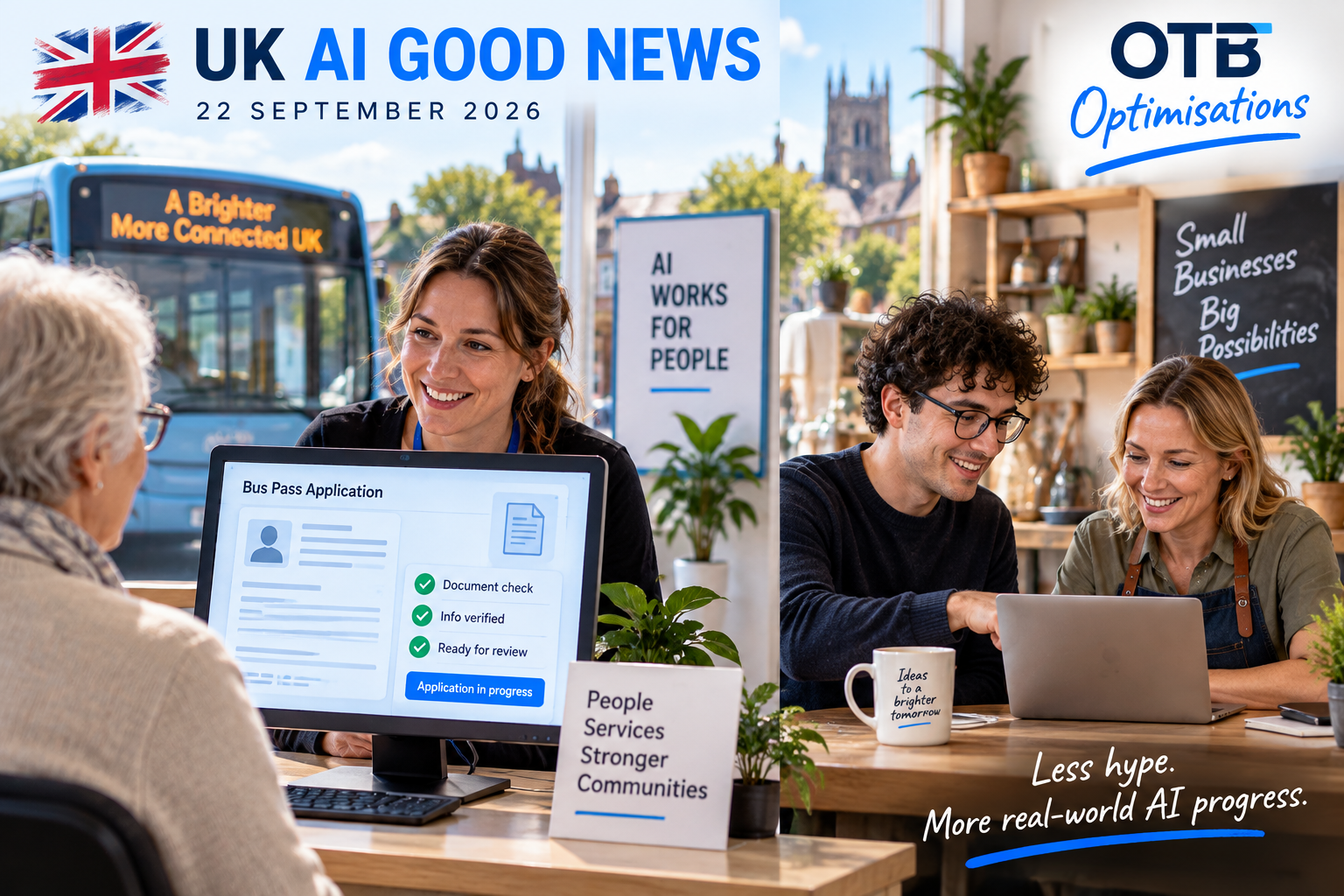
Worcestershire County Council has released results from an AI system being used to help process concessionary bus-pass applications.
During its first eight months, the council’s Bus Pass AI Agent processed nearly 2,500 applications and checked almost 7,500 uploaded documents.
Its job is relatively simple.
Before an application reaches a member of staff, the AI looks for common problems such as an incorrect photograph, date of birth or proof-of-address document.
The council says it has already identified hundreds of issues that could have delayed applications, allowing residents to correct problems earlier and reducing repeated contact with council staff.
And there’s an important part of this system that I particularly like.
The AI doesn’t make the final decision. A person does.
Human oversight remains in place, with council staff reviewing applications and making the final call.
This isn’t futuristic AI.
It’s AI doing a repetitive administrative job so people can spend more time doing the work where people are actually needed.
That’s potentially a very useful model for other public services and businesses.
Sources: Worcestershire County Council: AI helping the council work smarter ↗ · LocalGov: AI helps process 2,500 bus-pass applications ↗
Now UK small businesses are getting help finding practical uses for AI
There’s another interesting development in the East Midlands.
University of Leicester has announced a new 45-month East Midlands Pathways to AI Programme, funded by Innovate UK.
The idea is to connect university AI skills directly with real problems faced by local businesses.
Around 180 students a year are expected to benefit from the enhanced curriculum, while the programme plans to create 180 AI-focused internships over its lifetime.
There’s also a six-week AI for Business Accelerator, offered free to SMEs during the funded period.
Rather than simply teaching business owners how to use the latest chatbot, the programme is intended to help them identify genuine AI opportunities, manage projects and implement the technology responsibly. Students will also work on real organisational challenges involving AI problem-solving and workflow redesign.
This part is an announced programme, so we don’t yet have results showing how much time or money participating businesses will save.
But I really like the thinking behind it.
Source: University of Leicester: East Midlands Pathways to AI Programme ↗
Start with the problem
These two stories actually fit together rather well.
A council hasn’t introduced AI simply so it can say it uses AI.
It has found a repetitive administrative process involving thousands of documents and given the AI a specific job, while keeping a person responsible for the final decision.
And in Leicester, businesses are going to be encouraged to look at their own processes and identify where AI could genuinely help.
That’s exactly the approach I believe in at OTB Optimisations.
Don’t start with:
“What AI should we buy?”
Start with:
“What are we actually trying to make easier?”
Sometimes the answer will be AI. Sometimes it will be automation. Sometimes it may be something much simpler.
No AI for the sake of AI.
Less hype. More real-world AI progress.