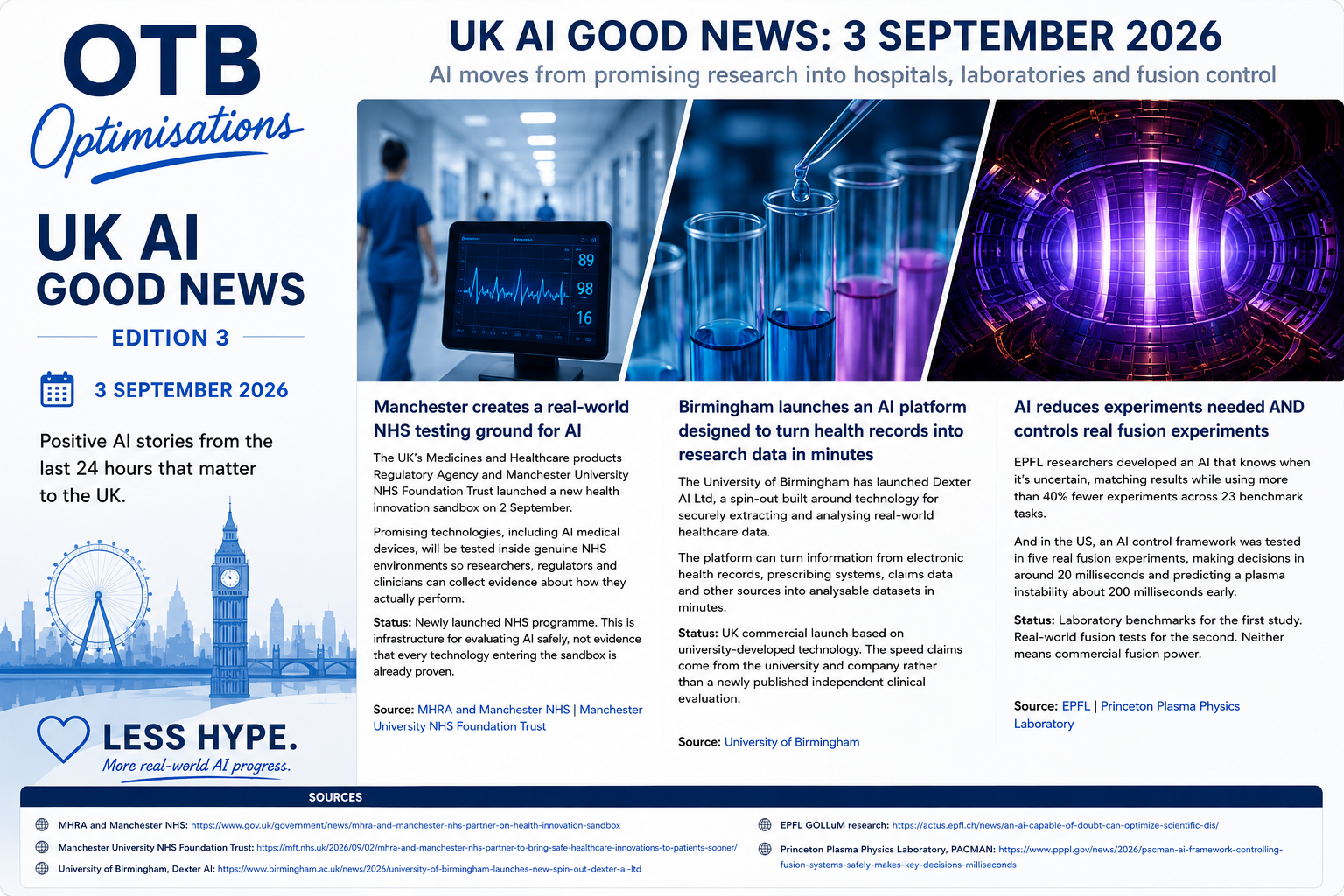
Today’s AI Good News shows something important happening with AI. It is increasingly moving beyond impressive demonstrations and into the places where it could make a practical difference.
From the NHS and medical research to scientific laboratories and even experimental fusion reactors, researchers are starting to use AI as a tool to help humans work faster, test more possibilities and respond to things we simply cannot react to quickly enough ourselves.
Manchester creates a real-world NHS testing ground for AI
The UK’s Medicines and Healthcare products Regulatory Agency and Manchester University NHS Foundation Trust have launched a new health innovation sandbox.
The programme will allow promising new healthcare technologies, including AI-enabled medical devices, to be tested in genuine NHS environments.
That means researchers, clinicians and regulators can gather evidence about how these systems actually perform in the real world rather than relying purely on laboratory testing.
Technologies demonstrated at the launch included AI-powered ambient voice tools already being used to support clinical care.
The goal is to help close one of healthcare AI’s biggest gaps: getting promising technology from prototype to something that can be proven safe and useful for patients.
Sources: MHRA — Manchester NHS health innovation sandbox ↗ · Manchester University NHS Foundation Trust ↗
Birmingham launches AI platform to turn health records into research data in minutes
The University of Birmingham has launched a new spin-out company called Dexter AI Ltd.
Its technology is designed to securely extract and analyse real-world healthcare data from sources including electronic health records, prescribing systems and claims data.
The university says Dexter can transform this information into datasets ready for analysis in minutes.
That could potentially speed up research into drug safety, treatment effectiveness, clinical audits and population health.
It may not sound as dramatic as an AI diagnosing a disease, but researchers can spend huge amounts of time cleaning and structuring health data before they can begin answering the question they actually want to investigate.
Reducing that workload could allow medical research to move considerably faster.
Source: University of Birmingham — Dexter AI Ltd ↗
An AI with a “doubt detector” can reduce the experiments scientists need
Researchers at EPFL in Switzerland have developed an AI framework called GOLLuM.
One of the problems with large language models is that they can confidently produce incorrect answers. GOLLuM approaches that problem differently by combining an LLM with a probabilistic system that explicitly measures uncertainty.
In simple terms, the AI learns not only which scientific experiments look promising, but also where it isn’t sufficiently certain.
Researchers tested it across 23 optimisation problems involving areas including chemistry, materials and molecular research.
Across those benchmarks, GOLLuM matched traditional methods while requiring more than 40% fewer experiments.
Within a 50-experiment budget, 36.3% of the conditions it selected were among the top 5% of possible outcomes, compared with 29.7% using the traditional comparison method. The work was published in Nature Machine Intelligence.
If results like these translate into real laboratory workflows, scientists could spend less time and money testing dead ends and more time investigating promising ideas.
Source: EPFL — An AI capable of doubt can optimise scientific discovery ↗
AI successfully controls parts of a real fusion experiment
This is probably my favourite story today.
Researchers at Princeton Plasma Physics Laboratory and Princeton University have developed an AI framework called PACMAN, short for Prediction And Control using MAchiNe learning.
And crucially, they haven’t only tested it in a computer simulation.
PACMAN was successfully tested on a real fusion system in five separate experiments.
The system combines multiple machine-learning models that monitor plasma and make control decisions in roughly 20 milliseconds.
In one test, an AI model predicted a damaging plasma instability around 200 milliseconds before it occurred, giving the control system time to respond.
The researchers also demonstrated AI control of heating systems inside the experiment.
Humans still decide the objectives and safety parameters, while the software enforces hardware safety limits before AI-generated commands reach the machine.
That’s an important distinction. The AI isn’t running a fusion reactor by itself. It’s handling extremely fast control decisions that would be physically impossible for a human operator to make in time.
Source: Princeton Plasma Physics Laboratory — PACMAN AI fusion control ↗
Why this matters
There’s a common thread running through today’s stories.
AI isn’t replacing the doctor, scientist or engineer.
It’s helping the NHS test technology more safely. It’s reducing the work required to prepare medical data for research. It’s helping scientists decide which experiments are worth performing. And it’s reacting to events inside a fusion experiment occurring in thousandths of a second.
That’s the version of AI worth paying attention to.
Less hype. More real-world AI progress.