One of the biggest things I’ve learned from using AI every day is that the best use of it often isn’t getting AI to do your job for you.
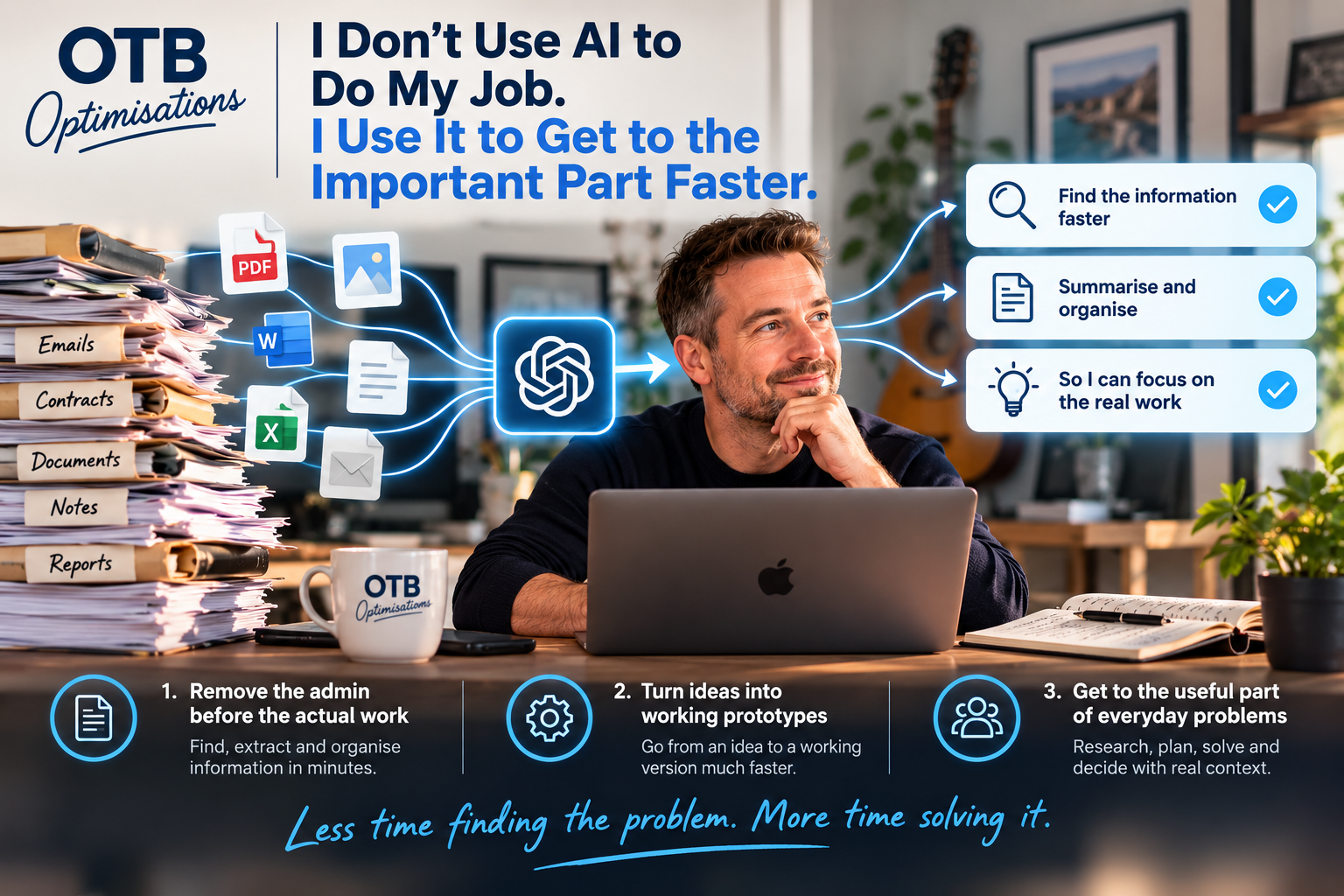
For me, it’s about using AI to get to the part of the job that actually needs me much faster.
Here’s a simple example.
Say I need to answer a question and I know the answer exists somewhere within a collection of files.
I could open every file, read through them, find the relevant sections, compare the information and eventually get to what I need.
Or I can give those files to AI and say:
“Find everything in these files relating to this issue.”
If that takes 2% of the time, I haven’t outsourced the important part of my job.
I still need to understand what I’m looking at.
I still need to make the decision.
I still need to solve the problem.
I’ve just removed most of the time spent getting to the problem in the first place.
And I’ve realised I use AI in this way constantly.
1. Getting through admin faster
Emails, documents, contracts, notes and customer information often contain exactly what I need.
The time-consuming bit is finding it, comparing it and putting it into a useful structure.
AI can do a lot of that groundwork.
I still deal with the customer. I still make the decision. I still take responsibility for the outcome.
But instead of spending 20 minutes finding the information I need, I might spend one minute.
That leaves more of my time for the bit that actually matters.
2. Turning ideas into working prototypes
This has probably been the biggest eye-opener for me.
I’ve used AI to help me create websites, software prototypes and automation tools.
That doesn’t mean typing “build me an app” and walking away.
I’m deciding what problem I’m trying to solve.
I’m deciding how it should work.
I’m testing it, finding problems, changing things and sometimes realising my original idea was wrong.
But AI has massively shortened the distance between:
“I’ve got an idea.”
and
“Let’s see if this actually works.”
Things I might previously have dismissed because I didn’t have the technical knowledge, time or budget to try them can now become working prototypes surprisingly quickly.
3. Getting to the useful part of everyday problems
I do exactly the same outside work.
Researching something I’m considering buying.
Understanding a problem with the car.
Working through numbers.
Planning something.
Helping with homework.
Even figuring out what I can cook with what’s in the kitchen.
Instead of starting with a generic Google search, I can give AI my actual situation.
Photos. Documents. Numbers. Context. Constraints.
That means I can often skip a huge amount of searching and get much closer to the point where I can actually make a decision.
And I think this is where businesses should start when they’re wondering how they could use AI.
Don’t start with:
“What jobs can AI do instead of us?”
Start with:
“What are we spending time doing before we get to the valuable part of our job?”
Searching.
Sorting.
Comparing.
Extracting.
Formatting.
Finding information.
Moving information from one place to another.
Those are often the opportunities.
I don’t want AI replacing the thinking I should be doing.
I want it removing the unnecessary steps that stop me getting to that thinking sooner.
For me, that’s what AI optimisation actually looks like.
Less time finding the problem. More time solving it.
Less hype. More real-world AI progress.