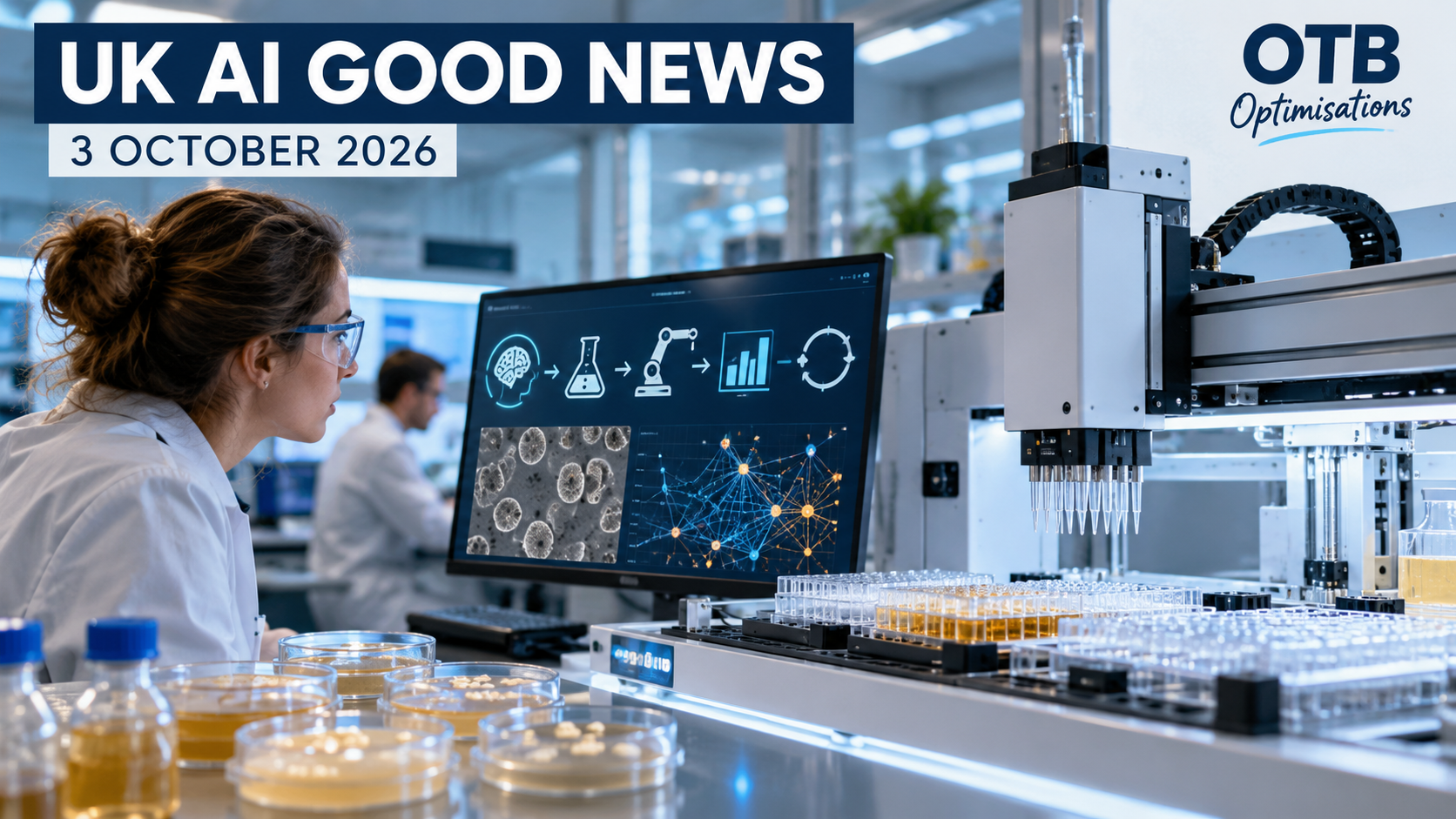
Something quite remarkable has happened in a laboratory in Sweden. Researchers have connected AI reasoning to laboratory automation, creating a system that can propose biological hypotheses, design experiments, analyse what happens and use the results to refine what it investigates next.
This is not just an AI generating scientific ideas on a computer. The ideas were tested in the physical world. There is a UK connection too: the research includes the University of Cambridge and received funding from the UK's Engineering and Physical Sciences Research Council.
The work was highlighted by Euronews on 2 October, following a Chalmers announcement on 30 September. This post looks at that coverage and the underlying peer-reviewed study, rather than claiming a new discovery was made today.
From AI prediction to actual experiments
The system was developed by researchers at Chalmers University of Technology and collaborators, and tested using brewer's yeast, Saccharomyces cerevisiae, an important organism in biological research.
The researchers supplied scientific knowledge about the yeast, including its genome, metabolism and previous studies. They combined large language models with structured biological knowledge, automated reasoning and experimental constraints to identify questions and propose experiments.
Those experiments were connected to automated cell-culture and laboratory equipment. Results came back into the system, allowing the AI to evaluate whether its hypotheses were supported and refine what it investigated next.
Hypothesis → experiment → real-world result → analysis → new hypothesis.
That is the scientific loop, and researchers have demonstrated AI operating across much more of it. It is an integrated workflow, not a chatbot acting alone, and some preparation, transfers and safety checks still required people.
Sources: Chalmers: research announcement ↗ · Peer-reviewed paper, full text ↗ · Euronews: 2 October coverage ↗
It discovered biological interactions
This was not simply a demonstration showing that the machinery worked. The study reports interactions in yeast biology identified and tested through the system.
One involved glutamate increasing growth inhibition in cells treated with spermine. Another found that aminoadipate could partially protect yeast cells from formic-acid stress.
Those may sound obscure, and they are. But that is partly the point. Modern biology contains an enormous number of possible interactions between genes, proteins, chemicals and environmental conditions. There are too many combinations for scientists to manually investigate everything.
AI-powered automated laboratories could potentially explore much larger areas of that scientific search space. These findings are about yeast under particular experimental conditions, not treatments demonstrated to work in people.
Sources: Chalmers: publication record and abstract ↗ · Journal of the Royal Society Interface: study ↗ · PubMed: study record ↗
There is an important British connection
Professor Ross King, one of the researchers behind the work, is affiliated with Cambridge's Department of Chemical Engineering and Biotechnology. The Chalmers announcement also lists the UK's Engineering and Physical Sciences Research Council (EPSRC) among the study's funders, alongside Swedish funding bodies.
King has been pursuing this idea for years. His earlier robot scientists included Adam, designed to conduct experiments and generate scientific knowledge, and Eve, developed with drug discovery in mind.
What has changed is the arrival of modern large language models and improved automated reasoning, which can be combined with laboratory robotics. Chalmers describes Eve as having been updated with those capabilities.
Sources: University of Cambridge: Ross King ↗ · Chalmers: funding, Adam and Eve ↗
Is this really an autonomous scientist?
Not completely. That is an important qualification.
The paper says people still prepared stock solutions and reference samples, handled occasional plate transfers, moved scripts and data between non-networked machines, and reviewed proposed experiments for safety. Human researchers also define the scope, set priorities, interpret broader significance and provide ethical oversight.
The experiments were conducted in a specific biological system, brewer's yeast. This does not mean an AI can independently walk into a cancer laboratory and discover a new drug.
But unlike many AI science announcements, there is demonstrated experimental evidence here. The work is published in the peer-reviewed Journal of the Royal Society Interface, and the hypotheses were tested using actual laboratory experiments.
Source: Full paper: human intervention and automation limits ↗
This is where AI gets really interesting
We have recently discussed Claude searching genomic databases and flagging an unusual enzyme system, with a closer look at what that finding does and does not show. This explores a different part of the process: connecting proposed experiments to laboratory testing and feeding the evidence back into the system.
Instead of AI simply saying “I have found something interesting. A scientist should test this”, we are beginning to see systems capable of proposing an experiment, connecting it to automated equipment, analysing what happened and refining what to test next.
Imagine eventually applying that approach to drug discovery, new materials, agriculture, climate science or disease research. Those are potential applications, not outcomes established by this yeast study.
It does not eliminate scientists. It potentially gives them the ability to explore far more ideas than they could manually. That is a much more interesting vision for AI than simply generating another email.
Less hype. More real-world AI progress.