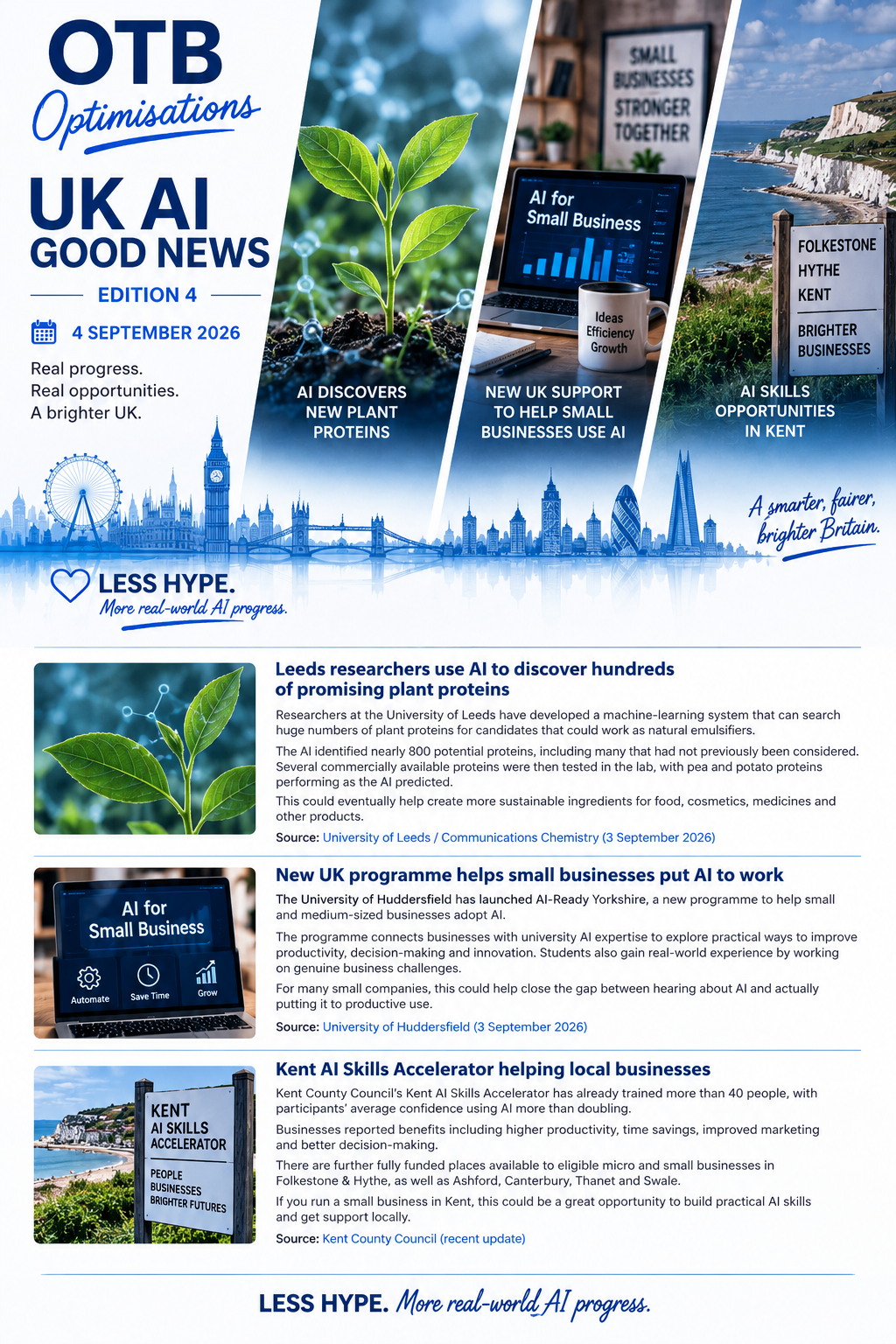
Today’s UK AI Good News has a particularly practical theme.
Researchers are using AI to search through huge numbers of possible sustainable ingredients, while a new UK programme is helping small businesses work out how AI could actually improve their day-to-day operations.
And closer to home, there is also a fully funded opportunity for eligible Kent businesses to learn how to use AI effectively.
Leeds researchers use AI to discover hundreds of promising plant proteins
Researchers at the University of Leeds have developed a new approach combining artificial intelligence and statistical physics to search huge numbers of plant proteins for candidates that could work as natural emulsifiers.
Emulsifiers help ingredients such as oil and water remain mixed and are widely used in food, cosmetics, pharmaceuticals and other products.
The system identified nearly 800 plant proteins with potential emulsifying properties, many of which had not previously been considered for the job.
Importantly, this wasn’t purely a computer simulation.
Researchers tested several commercially available proteins in the laboratory. Pea and potato proteins demonstrated effective emulsification properties, supporting the predictions made by the AI-driven approach.
The technology could eventually help researchers find more sustainable ingredients without having to experimentally test millions of possibilities one at a time.
Source: University of Leeds — AI identifies hundreds of promising plant proteins ↗
New UK programme helps small businesses put AI to work
A new programme called AI-Ready Yorkshire is being launched by the University of Huddersfield to help small and medium-sized businesses explore practical ways of using artificial intelligence.
Many SMEs recognise that AI could be useful but don’t necessarily have the time, expertise or resources to work out where it would make a genuine difference.
AI-Ready Yorkshire is designed to tackle exactly that problem.
Businesses will be connected with students and graduates from the university’s AI and Computer Science courses to work on real organisational challenges.
Projects could involve areas such as data analysis, automation, predictive modelling and AI-assisted decision-making.
At least 60 student placements and graduate traineeships will be supported over three years, with approximately £300,000 of funding through the government’s TechLocal programme.
For small businesses, this is a good example of AI adoption moving beyond simply giving employees access to ChatGPT.
It’s about looking at the actual operation of a business, identifying repetitive work or difficult decisions and then applying the right technology to solve those problems.
Source: University of Huddersfield — AI-Ready Yorkshire ↗
Local opportunity: Fully funded AI training for Kent small businesses
This one wasn’t announced yesterday, but it’s too useful for local businesses to ignore.
The Kent AI Skills Accelerator has already trained more than 40 people from Kent businesses.
Kent County Council says participants’ average confidence using AI more than doubled during the programme, with businesses also reporting benefits around productivity, time saving, marketing, decision-making and responsible AI use.
And there are further fully funded places available for eligible micro and small businesses in:
Folkestone & Hythe, Ashford, Canterbury, Thanet and Swale.
The available training includes a City & Guilds Assured qualification in AI Prompt Engineering and training covering AI Governance & Ethics.
For small businesses around Kent that know AI could help but aren’t sure where to begin, this looks like a genuinely useful opportunity.
Source: Kent County Council — Kent AI Skills Accelerator ↗
Why this matters
There’s a nice connection between today’s stories.
At one end, AI is helping researchers search through possibilities that would be extremely expensive and time-consuming to investigate manually.
At the other, we’re seeing programmes designed to help ordinary UK small businesses work out where the same technology can save time, improve decisions and increase productivity.
And that second part matters.
Small businesses don’t necessarily need an “AI strategy”.
They need to identify the jobs that consume time, the repetitive paperwork, the information that’s difficult to find and the processes that could work better.
Then they can decide whether AI is actually the right tool for the job.
That’s when AI stops being hype and starts becoming useful.
Less hype. More real-world AI progress.