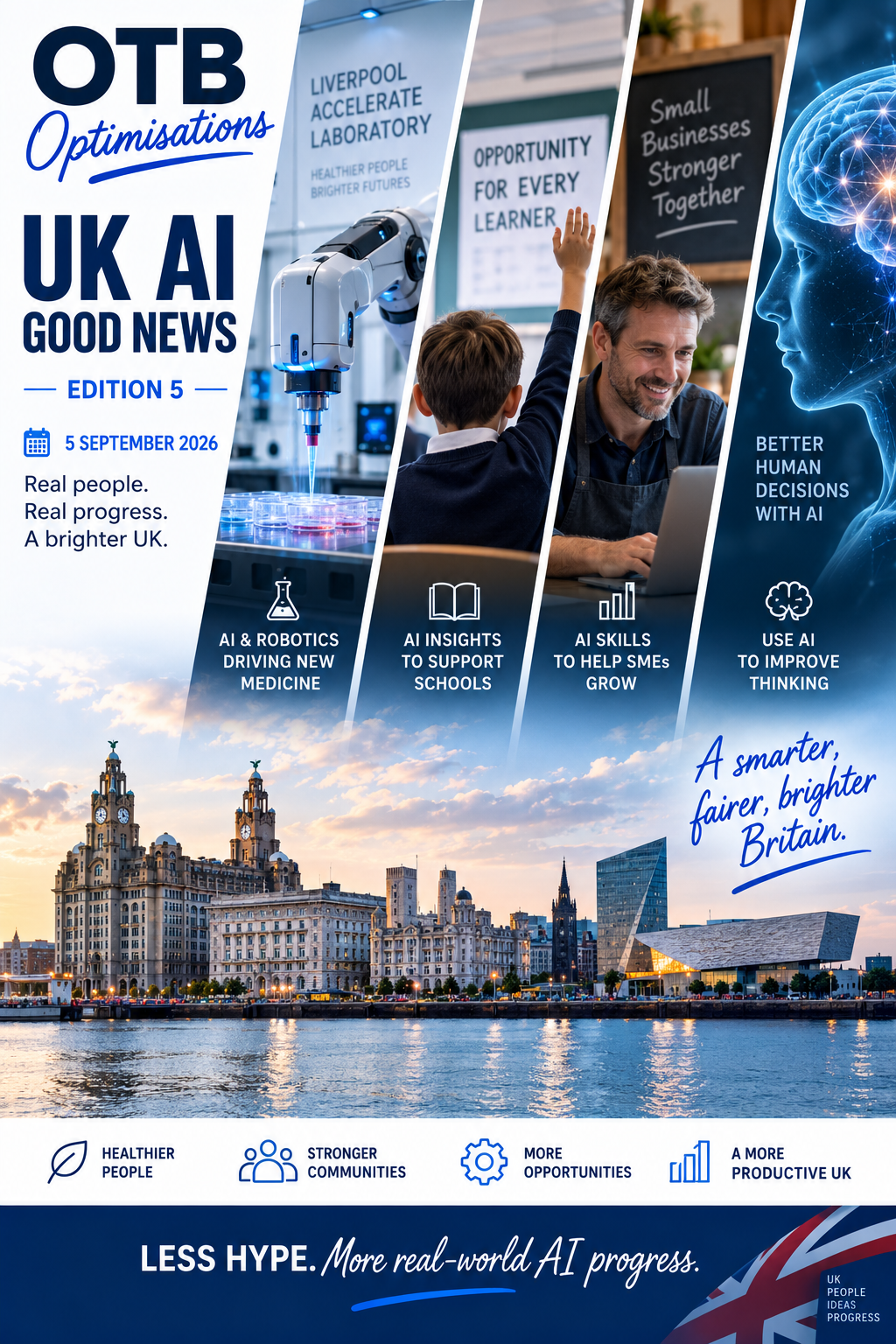
Today’s UK AI Good News is heavily focused on practical use.
A new £20 million Liverpool laboratory is combining AI, robotics and human organoids to accelerate drug and vaccine research, while an AI-assisted study has analysed more than 1,200 school strategies to identify the biggest challenges facing disadvantaged pupils.
There is also a useful small-business story from Sunderland, where a new funded project will pair AI-skilled jobseekers with local small businesses that want help putting the technology to work.
£20 million robotic AI laboratory launches in Liverpool
A new high-security laboratory combining artificial intelligence, robotics and human organoid technology has launched in Liverpool.
The Liverpool Accelerate Laboratory has been developed by the Liverpool School of Tropical Medicine and the Infection Innovation Consortium, iiCON.
Its purpose is to speed up the discovery of new drugs and vaccines for high-risk infectious diseases.
Instead of relying solely on animal testing, the facility will use human organoids, miniature models of organs grown from human cells, to provide researchers with a more human-relevant way of testing potential treatments.
AI, machine learning and automated laboratory equipment will then help researchers carry out experiments at greater speed and scale.
The £20 million facility has received £10 million of Liverpool City Region funding and is expected to open fully in 2027.
It will also be available to businesses, including SMEs and start-ups, that want to test new drugs and vaccines using organoid models.
Source: Liverpool City Region — Liverpool Accelerate Laboratory ↗
AI analyses more than 1,200 school strategies to reveal where pupils need support
The Education Endowment Foundation has published new research analysing how schools across England are supporting disadvantaged pupils.
Researchers used an AI model to analyse more than 1,200 Pupil Premium strategy statements from primary and secondary schools.
The analysis found that 91% of schools identified literacy and English attainment as a challenge, while 83% identified attendance.
Among secondary schools, attendance was identified as a challenge by 92%.
The research gives policymakers and schools a national picture of what teachers themselves are seeing on the ground, without researchers having to manually analyse thousands of lengthy strategy documents.
This is a less flashy use of AI, but a potentially valuable one: helping turn large amounts of public-sector information into evidence that can inform decisions about where support and funding are most needed.
Source: Education Endowment Foundation — challenges to disadvantaged pupils’ attainment ↗
New AI project pairs skilled people with small businesses
A new initiative in Sunderland has secured backing through Innovate UK’s Tech Local Programme.
The Sunderland AI Buddy Recruitment Pilot will pair digitally skilled jobseekers with small-business owners so they can gain real-world experience while helping businesses understand where AI might actually improve their operations.
The idea tackles two problems at once.
People trying to enter AI and digital careers gain practical business experience, while small firms that do not have an internal technology team get help understanding and implementing AI.
For SMEs, this is exactly the type of support that can make AI adoption more realistic. Rather than simply telling a business to “use AI”, someone works alongside them to find practical applications.
Source: MySunderland — Sunderland AI Buddy Recruitment Pilot ↗
A useful warning for businesses using AI
One other UK study from yesterday is worth including because it fits the less hype philosophy of the series.
Researchers led by the University of Bath warned that managers who rely too heavily on generative AI could gradually weaken their own judgement and practical knowledge.
But the study did not argue that businesses should avoid AI.
Instead, researchers suggested AI can actually strengthen human judgement when it is used to challenge assumptions, explore alternatives and encourage managers to think more deeply rather than simply outsourcing decisions to the machine.
For small businesses, that is probably one of the most useful principles to remember:
Use AI to improve your thinking, not replace it.
Source: University of Bath — AI and managers’ judgement ↗
Why this matters
Today’s stories show several different versions of useful AI.
In Liverpool, AI and robotics are helping scientists build a faster way to research dangerous infectious diseases.
In education, AI is helping researchers make sense of more than a thousand school reports to identify where disadvantaged pupils need the most help.
In Sunderland, it is being used to help small businesses gain practical AI capability.
And the Bath research provides an important reminder that the best results will probably come when AI supports human judgement rather than replacing it.
That feels much closer to what useful AI adoption should actually look like.
Less hype. More real-world AI progress.