Most people use ChatGPT by asking it a question and getting an answer.
But there’s another way of using it that could be far more valuable, particularly for learning.
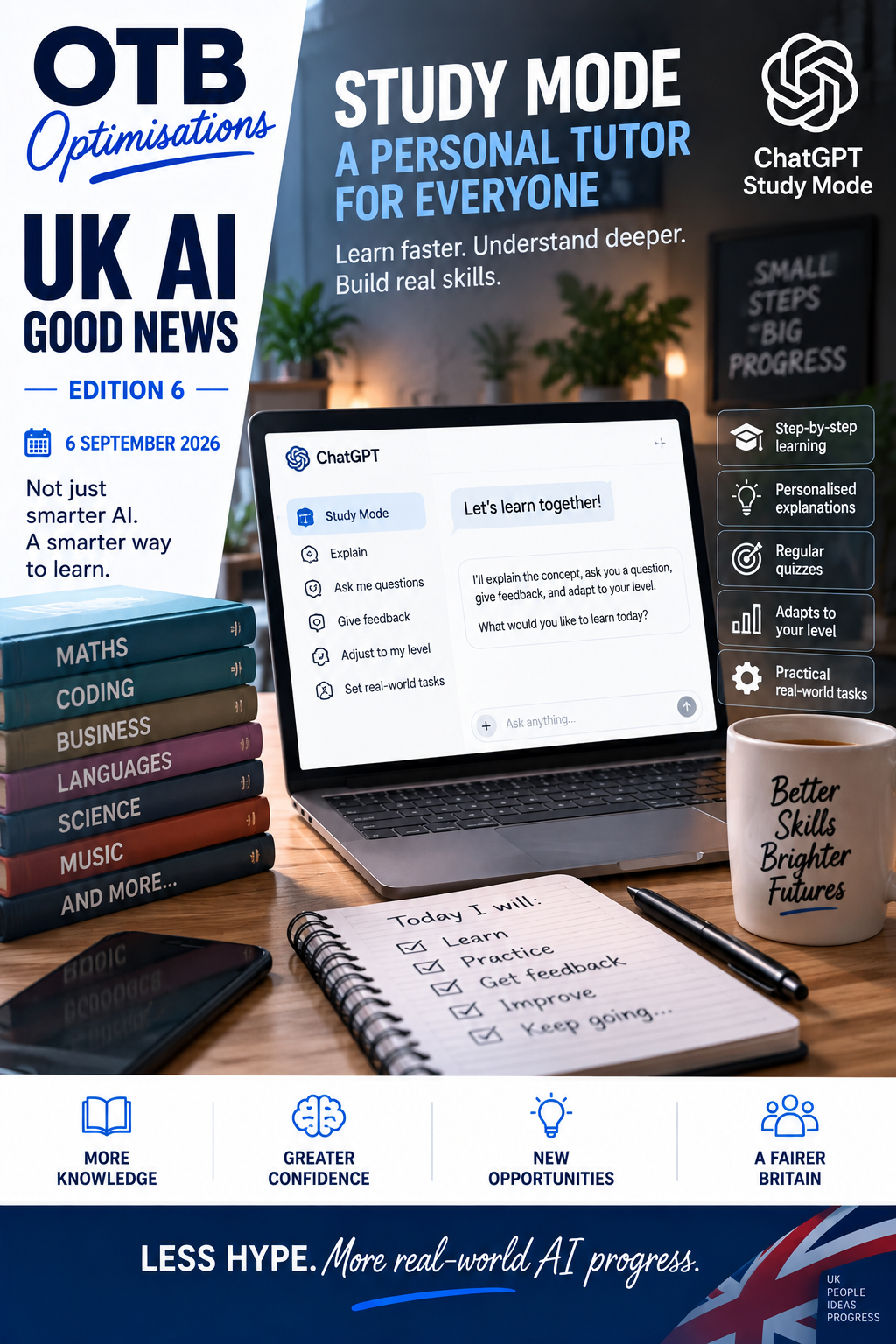
Study Mode turns ChatGPT from an answer machine into something much closer to a personal tutor.
Instead of immediately telling you the answer, Study Mode can ask questions, work through a subject step by step, check whether you actually understand it and adjust its explanations depending on how you’re getting on.
And it isn’t restricted to students.
You could use it to learn coding, understand AI, improve your maths, study a language, learn business concepts, revise science, understand something for work or simply explore a subject you’ve always wanted to understand.
Learning that adapts to you
Traditional education usually has to teach groups of people at roughly the same pace.
Study Mode can work differently.
You can tell ChatGPT what you already understand and what you’re struggling with. It can start with a simple explanation, add complexity as you improve, ask open-ended questions and give feedback when you’ve misunderstood something.
You can even tell it:
Don’t give me the answer. Help me work it out.
That distinction is important.
Used badly, AI can simply do the work for us.
Used properly, it could help us get better at doing the work ourselves.
Turn your own material into a lesson
Study Mode can also work with material you provide.
Upload class notes, a worksheet, a syllabus, slides, a PDF or even a photograph of a problem, and ChatGPT can use that material while helping you understand it.
You can ask it to quiz you one question at a time, identify gaps in your knowledge, explain something differently when you don’t understand it, or increase the difficulty when you’re ready.
That creates a fascinating possibility.
Rather than everybody receiving exactly the same lesson, AI can potentially provide a learning experience that responds to the individual.
Could it actually improve learning?
There is some early evidence worth watching.
OpenAI says it has been studying pedagogically aligned AI with more than 300 college students preparing for neuroscience and microeconomics exams. Its analysis is still underway, so this should not be treated as definitive proof, but OpenAI says its early results give it confidence that this style of AI interaction can improve learning outcomes.
The bigger question is whether those gains remain over time.
That’s exactly the sort of thing future independent research needs to establish.
Sources: OpenAI — Using Study Mode in ChatGPT ↗ · OpenAI — Understanding AI and learning outcomes ↗
Why this matters
For centuries, individual tuition has been limited by something very simple.
It requires another person’s time.
That makes high-quality one-to-one teaching expensive and difficult to provide at scale.
AI changes that equation.
It doesn’t replace great teachers, and ChatGPT can still make mistakes. OpenAI itself says Study Mode should be used as a study aid rather than a replacement for teachers or course materials.
But imagine millions of people having access to something that can explain a difficult idea five different ways, patiently answer questions, quiz them, identify what they don’t understand and continue teaching for as long as they want.
That could be significant not just for schools, but for adults trying to retrain, employees learning new skills and small-business owners trying to understand technology that previously felt inaccessible.
The exciting part of AI isn’t simply that it can know things.
It’s that it might help more of us learn things.
Less hype. More real-world AI progress.