From eye scans to head injuries, some of the most useful healthcare AI research starts with a specific problem rather than a promise to replace doctors.
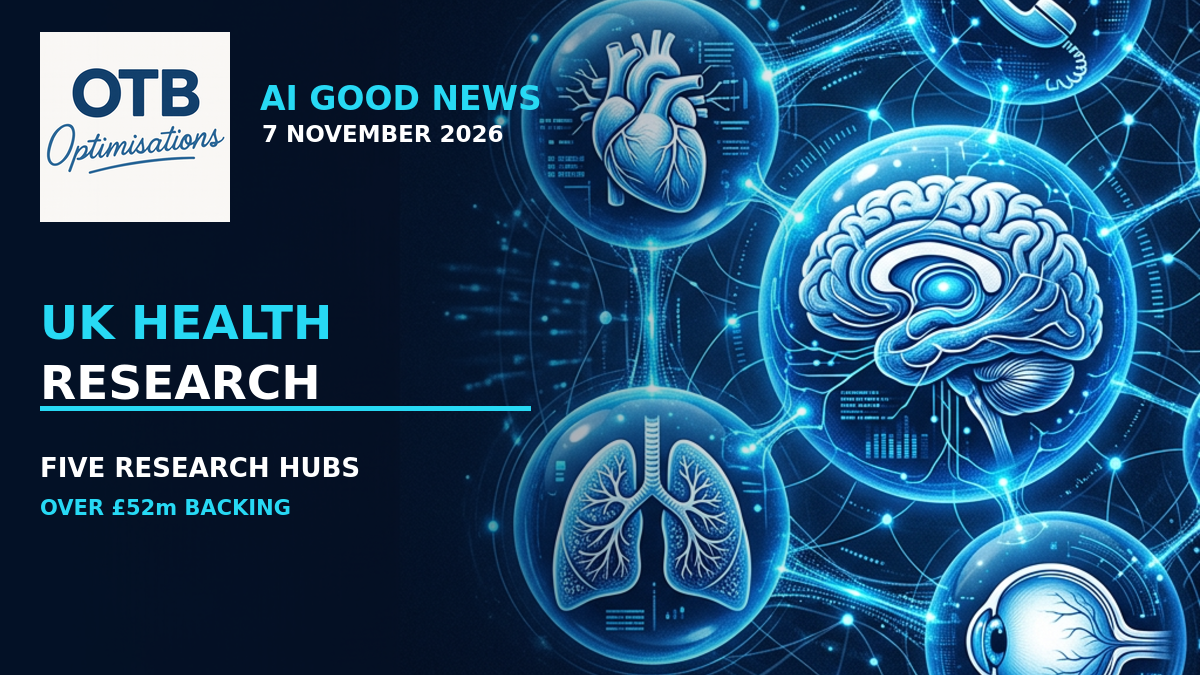
On 6 November 2026, UK Research and Innovation announced more than £52 million in government backing for five healthcare research and partnership hubs. A separate Newcastle University announcement described an NHS trial of an AI telephone assistant for people with osteoporosis.
These are different projects with different aims. Together, they show investment in developing and testing technology around real care needs, not proof that the anticipated benefits have already arrived.
Five Hubs, Five Practical Areas of Research
The UKRI programme brings universities together with the NHS, patients, charities and industry. Partners will provide an additional £37.5 million in cash and in-kind contributions. That is not all additional government cash. The £1 million Life Science Programme contribution is already included in the government investment, so it should not be counted twice.
- BRAINIAC, University of Exeter: plans to combine blood tests, brain scans and digital information in a network of NHS brain health clinics. Ten sites and more than 1,700 patients will help test approaches to dementia risk and diagnosis. Faster diagnosis is an aim, not an achieved result.
- BRAIN-SAFE, Imperial College London: will develop models of individual brain-injury risk after head impacts, with possible applications in sport, road collisions and protective equipment.
- HeartTech, King’s College London: will combine wearable-device data, advanced imaging and health records to explore earlier risk identification and community cardiovascular care, including a proposed AI wellbeing coach.
- CRISP, University of Southampton: will develop sensors, cough and breathing analysis, and rapid tests for respiratory infections. The ambition is to help assess likely illness progression and when professional advice may be needed.
- NORI, University of Sunderland: will investigate AI analysis of routine eye scans alongside health records and community data, initially focusing on clues to diabetes and cardiovascular disease.
These summaries describe planned research. They do not establish that an eye scan now reliably predicts every future illness, that dementia diagnosis has already become 50% faster, or that a phone app can safely replace clinical assessment.
Dora: A Separate Trial in NHS Care
Newcastle University’s 6 November release describes a two-year project trialling Dora Care, a generative-AI telephone assistant for people with osteoporosis. The condition weakens bones and can require ongoing monitoring through fracture liaison services.
The project is led by Ufonia, working with Newcastle University and the University of York, with Innovate UK funding. The AI holds spoken conversations over the phone. Linguistics researchers studied how clinicians communicate empathy to inform the design, while York specialists are developing a safety framework.
Most importantly, participation is voluntary. The calls supplement patients’ regular NHS care rather than replace it. The trial has medical and ethical approval, but approval to investigate a technology is not evidence that it improves outcomes.
Safety Includes What Happens After the Call
A natural-sounding conversation is not the same as a correct clinical assessment. Evaluation needs to consider whether important information is captured, concerns reach appropriate professionals and patients understand the service they are using.
People may communicate differently, have hearing difficulties or prefer a person. Those are important questions for accessible evaluation, not reasons to assume all patients will welcome an automated call.
The Positive Part
The common strength is attention to specific problems, clinical involvement and testing. Better early detection and more consistent follow-up would be valuable, but they need evidence that goes beyond a technically impressive demonstration.
Backing researchers and evaluating a service alongside normal care are sensible steps towards discovering where AI helps. Keeping those steps distinct from proven outcomes makes the news more credible, not less hopeful.
Sources and Further Reading
- UKRI: New technology to spot illness years earlier gets UKRI backing. Published 6 November 2026. Primary source for all five hubs, government investment, partner contributions and planned work.
- Newcastle University: NHS trials AI phone assistant for patients with long-term illness. Published 6 November 2026. Primary university account of Dora Care, its partners, safety work, voluntary participation and supplementary role.
Less hype. More real-world AI progress.