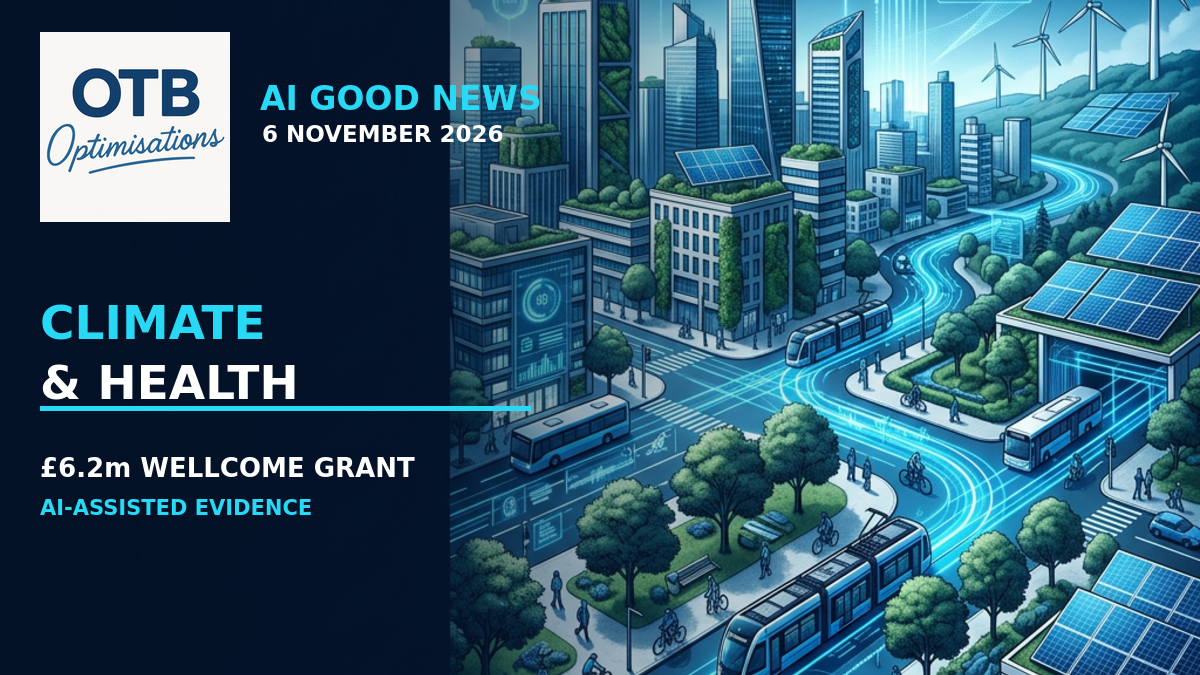
A city considering cleaner transport or better buildings needs more than an ambitious climate target. It needs reliable evidence about health, cost and what is likely to work for the people who live there.
Researchers at the London School of Hygiene & Tropical Medicine are receiving £6.2 million from Wellcome to help make that evidence easier to find and use. Announced on 5 November 2026, the funding supports the third phase of the Pathfinder Initiative, including new AI-assisted research tools.
Turning a Growing Literature into Useful Evidence
Climate and health research spans transport, energy, food, buildings and other sectors. A decision-maker may need to understand effects on air quality, physical activity, health inequalities and public spending at the same time.
Finding individual papers is only the start. The harder task is assessing their quality, comparing different settings and deciding whether their conclusions apply locally. A result from one city may not transfer directly to another with different infrastructure, incomes or weather.
The new programme, called Pathfinder 3: achieving a healthy net zero 2030, will develop AI-powered tools to accelerate evidence synthesis and generation. The aim is to provide a more timely picture of what works, where and at what cost.
There Is Already an Evidence Map
This is not a project starting with nothing. A previous phase produced a living evidence map that uses AI to gather climate and health research automatically at scale. Pathfinder 3 will build on that existing resource to maintain a current view of the research.
That distinction matters. The earlier evidence map exists, but the newly funded tools and their future impact should not be described as already delivered. Funding is a commitment to further work, not a completed evaluation.
Keeping a map current also does not make every included study equally dependable. AI-assisted collection still needs sound methods for checking relevance, study quality and uncertainty. A large evidence library can be useful without being a definitive answer to every policy question.
Decision Support for Cities
The team also plans an AI-assisted tool offering context-specific analysis for city climate and health decisions, particularly in low- and middle-income settings. It will build on earlier city-level research and practical implementation lessons.
The programme will assess environmental, health and economic impacts and develop guidance on evaluating climate actions. A central resource hub is planned to bring together methods, tools and case studies.
For example, choosing a transport policy involves more than estimating carbon savings. Local leaders may also need to consider who can use it, whether it changes exposure to air pollution and how costs and benefits are distributed. Those are examples of relevant decisions, not claims that the new AI tool has already solved them.
What the Funding Does Not Prove
The announcement does not show that Pathfinder 3 has reduced deaths, lowered hospital admissions or made a particular city healthier. Nor would a prediction alone establish that an intervention caused an improvement.
Useful tools must make assumptions and uncertainty visible. Decision-makers still need local knowledge, public involvement and accountability, especially where health benefits and financial costs fall on different groups.
Why It Is Worth Watching
The encouraging part is a practical use of AI: helping researchers organise evidence so people can make better-informed decisions. It is not a proposal to let a chatbot run climate policy.
If the work succeeds, more accessible evidence could help cities choose and assess actions with climate and health benefits together. For now, the genuine progress is sustained funding, an existing research foundation and a clear plan to test more useful ways of supporting decisions.
Sources and Further Reading
- LSHTM: £6.2m funding for research to accelerate climate action for health. Published 5 November 2026. Primary source for Wellcome funding, the third phase, existing evidence map and planned city decision-support tools.
- Pathfinder Initiative: AI-powered map of climate and health evidence. Existing evidence-map resource linked by LSHTM. It belongs to the previous phase, not an already completed output of the new grant.
Less hype. More real-world AI progress.