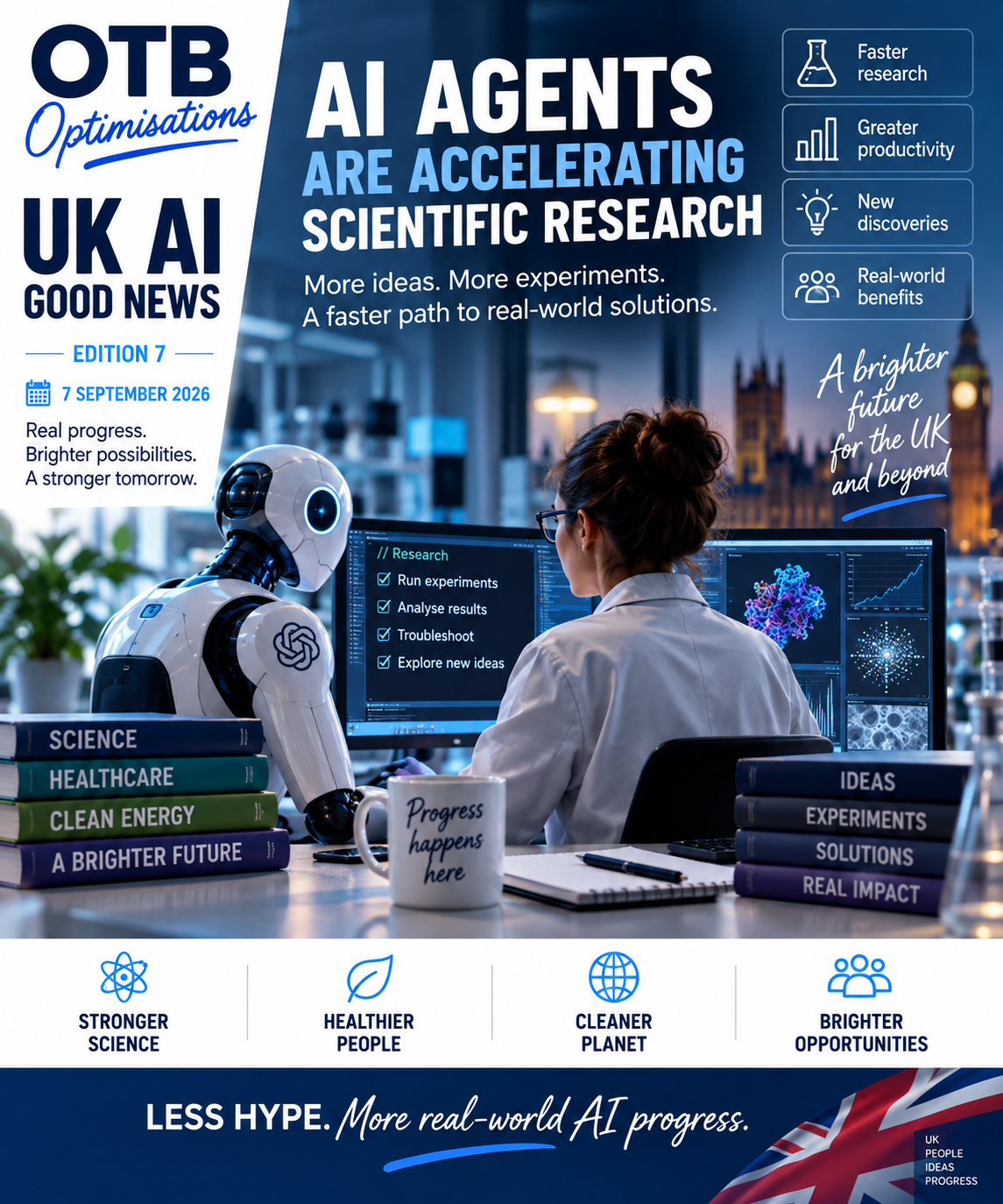
AI agents are often talked about as something that could transform the way we work in the future.
But new data published by OpenAI on 6 September 2026 gives us a fascinating glimpse of what is already happening when researchers work alongside AI agents every day.
OpenAI says its researchers are increasingly using coding agents throughout the day to write code, troubleshoot research infrastructure, run experiments and tackle increasingly complex technical tasks.
And the scale is already significant.
3.1 AI agent-workdays for every human workday
By mid-August, OpenAI says its research organisation was using the equivalent of 3.1 agent-workdays of effort for every human workday.
That does not mean three AI employees have replaced every researcher.
Instead, researchers can run AI agents alongside themselves, sometimes several concurrently, allowing software to continue working on technical tasks while the researcher concentrates on something else.
It’s an early glimpse of what working alongside increasingly capable AI agents could look like.
Researchers are running more experiments
OpenAI also reports that the number of experiments carried out per active researcher reached its highest level since tracking began in January 2025.
The increase correlates with greater use of Codex, although OpenAI is careful to point out that its available computing power has also increased substantially.
So this isn’t proof that AI alone caused the increase.
But the direction is interesting.
AI isn’t simply helping researchers write things faster.
It’s increasingly becoming part of the research process itself.
AI is being given harder jobs
The types of jobs researchers give these agents are changing too.
OpenAI says agents are increasingly handling longer and more complex tasks, including building research code, running experiments, analysing results and troubleshooting technical infrastructure.
There are still significant limitations.
For successful tasks estimated to take a human four to eight hours, more than half still required at least one human intervention.
Humans also continue to decide what research to pursue, judge which results matter and decide whether systems should be developed, paused or deployed.
Source: OpenAI — Research acceleration: The view inside OpenAI ↗
Why this matters
This could become one of AI’s most important contributions to science.
Research isn’t limited simply by whether someone can come up with a brilliant idea.
Scientists and engineers spend enormous amounts of time writing software, debugging experiments, analysing data, repeating tests and solving technical problems.
If AI can reliably take over some of that workload, researchers could potentially test far more ideas in the same amount of time.
And there’s a lesson here for ordinary businesses too.
A small-business owner doesn’t need an AI capable of inventing new science.
They might simply need an agent capable of researching something, preparing paperwork, analysing information or completing repetitive digital work while they concentrate on customers and running their business.
That is where agentic AI becomes particularly interesting.
Not because the human disappears.
Because one person may be able to achieve considerably more.
Less hype. More real-world AI progress.