This was a relatively quiet 24 hours for genuinely demonstrated new AI breakthroughs in the UK, so I am not going to pad today’s edition.
Instead, two developments from 14 September stood out because they show AI being applied to very different real-world problems: one enormously ambitious, and one extremely practical.
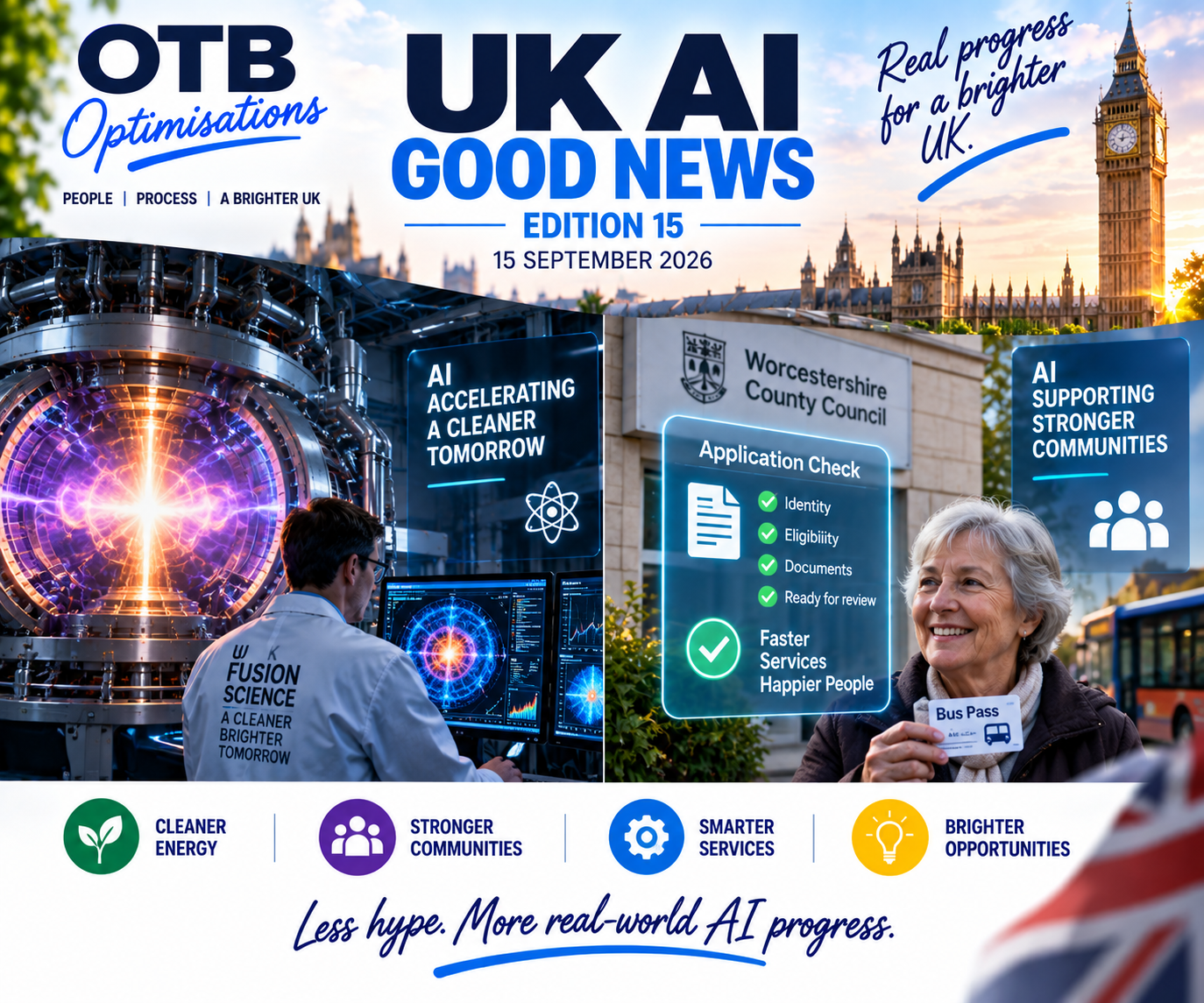
1. UK and US link AI supercomputing in the race for fusion energy
This is today’s biggest story.
The UK Atomic Energy Authority and the US Princeton Plasma Physics Laboratory have agreed to explore linking two powerful research platforms: Britain’s SUNRISE AI supercomputer and America’s STELLAR-AI.
Why?
To use AI and advanced computing to accelerate research into fusion energy, the same fundamental process that powers the Sun.
Fusion has the potential to provide enormous amounts of low-carbon energy, but scientists still face formidable engineering and physics challenges before commercial fusion power becomes a reality.
The new UK-US collaboration is intended to allow researchers on both sides of the Atlantic to combine AI, simulation, computing power and experimental data to tackle those problems faster.
The UK government is investing £45 million in the SUNRISE supercomputer as part of a wider £125 million AI Growth Zone investment at Culham, one of Britain’s most important fusion research centres.
If AI can help scientists model plasma behaviour, analyse experiments and identify promising approaches more efficiently, this is exactly the kind of AI application that could ultimately matter far beyond the technology industry.
Sources: UK Government announcement ↗ · UK Atomic Energy Authority — SUNRISE ↗
2. Worcestershire Council puts AI to work on bus-pass applications
At the opposite end of the scale, this is a brilliant example of the sort of AI application that rarely makes national headlines.
Worcestershire County Council is introducing AI into some of its public-service workflows.
One example is an AI agent designed to check evidence submitted with concessionary bus-pass applications before it reaches council staff.
Rather than an employee manually working through every initial check, the system can help validate the information first, allowing staff to concentrate on cases that actually require human attention.
The council has already developed more than 100 digital applications since beginning its low-code programme in 2015, and is now adding AI capabilities to those existing systems.
This is not as spectacular as AI helping scientists pursue fusion power.
But it may be a better illustration of how most people will actually experience AI.
Not a humanoid robot.
Not artificial superintelligence.
Just less repetitive administration and a public service that hopefully works a little faster.
Sources: Worcestershire County Council — AI strategy ↗ · Council bus-pass service ↗
The interesting connection between these two stories
A fusion laboratory and a council bus pass department could hardly be further apart.
Yet both illustrate the same underlying idea.
The most valuable question isn’t necessarily:
“What can AI do?”
It is:
“What problem do we have that AI could help us solve?”
For fusion researchers, that problem involves enormously complex scientific data and computation.
For a council employee, it might simply be checking whether somebody has supplied the correct evidence with an application.
Both are valid uses of the technology.
And that second example is particularly relevant to small businesses.
At OTB Optimisations, that is exactly what I am interested in finding.
Not adding AI because everybody is talking about AI, but looking at an existing process, finding where people are wasting time on repetitive work and asking whether technology can make it easier.
Sometimes the best AI innovation isn’t revolutionary.
It just gives somebody some of their day back.
Explore: Visit OTB Optimisations →
Less hype. More real-world AI progress.