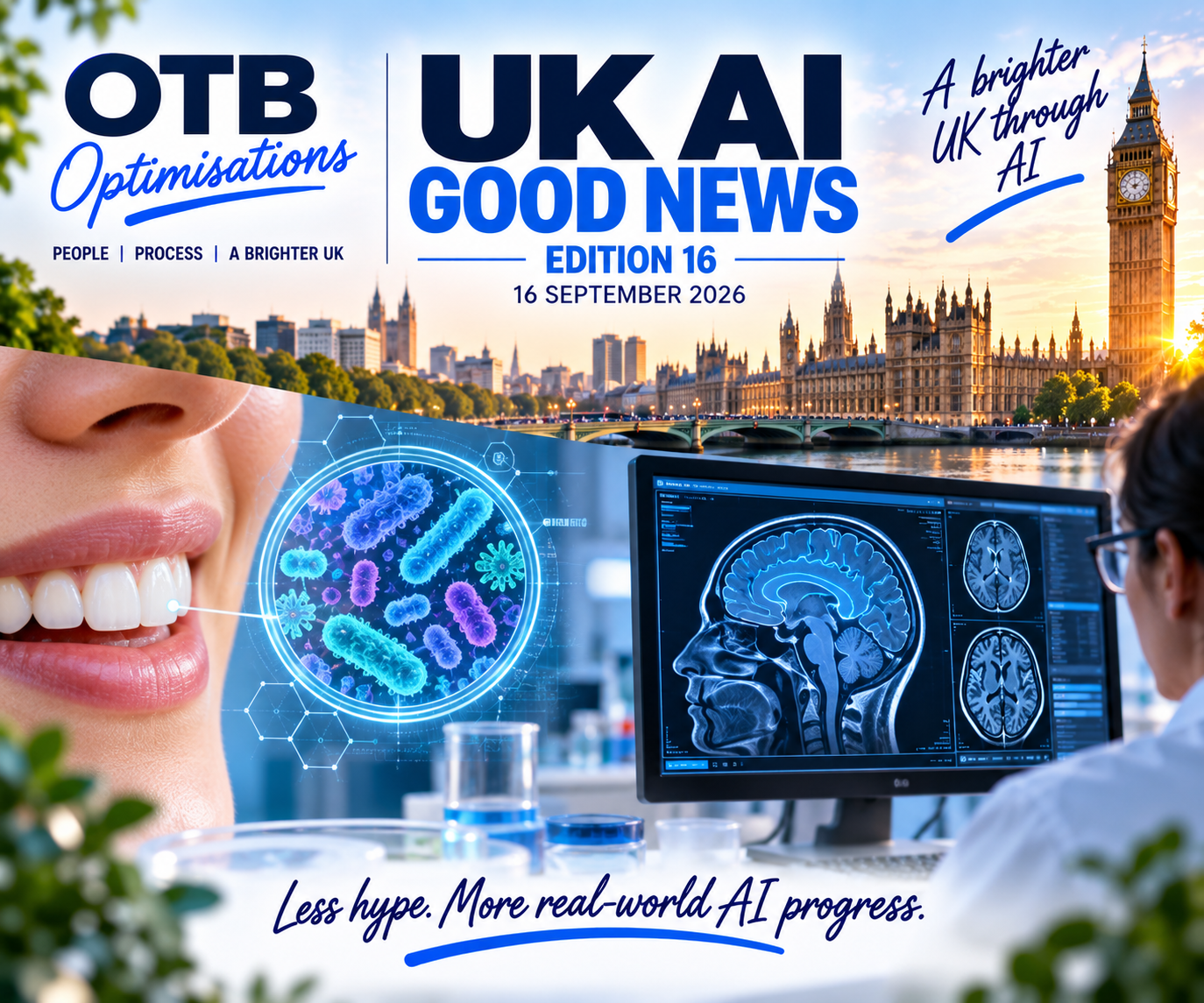
There are two particularly good UK healthcare stories in today’s edition, both published on 15 September.
Neither is a finished NHS treatment yet, so I’ve kept the distinction between promising research and demonstrated clinical use clear.
1. UK researchers use AI to spot the biological signature of serious gum disease
This is a really interesting example of AI finding patterns that are difficult for humans to untangle.
Researchers at the UK’s Hartree Centre, working with IBM Research and Salient Bio, have developed an AI-powered method for analysing the complex community of bacteria living in our mouths.
The team used metagenomic sequencing and AI analysis to identify a 13-species diagnostic signature associated with periodontitis, a severe form of gum disease affecting hundreds of millions of people globally.
Why does that matter?
Traditional approaches can concentrate on individual harmful bacteria. The researchers instead used AI to look at how the whole microbial community changes when the mouth moves from a healthy state towards disease.
The longer-term goal is particularly exciting: identifying people at risk before serious symptoms develop, allowing earlier and more targeted treatment.
There could also be another benefit. Earlier targeted interventions could potentially reduce reliance on broad-spectrum antibiotics.
Source: Hartree Centre announcement ↗
2. AI could help some brain-tumour patients avoid MRI dye injections
Researchers involving University College London have investigated whether AI can predict information normally revealed after injecting a contrast agent called gadolinium during a brain MRI.
The researchers assembled 11,089 MRI studies from more than 8,500 patients across the UK, US, Netherlands and Nigeria.
When tested on more than 1,100 non-contrast scans, the AI correctly predicted whether a tumour would brighten after contrast 83% of the time. It identified 92% of tumours that would brighten and 74% of those that would not.
Why is this potentially useful?
If doctors could identify some cases where contrast is likely to be necessary before the patient leaves, AI could potentially help patients avoid a second hospital visit, reduce delays and ultimately reduce unnecessary use of gadolinium.
But there is an important caveat.
The researchers explicitly say the system is not currently accurate enough to replace contrast-enhanced MRI, particularly for children. They see it initially as a decision-support or triage tool.
That’s exactly the distinction we need to make with healthcare AI. Promising does not mean ready for routine clinical use.
Source: UCL research report ↗
What I like about today’s stories
Both involve AI doing something it is particularly well suited to: finding useful patterns in huge amounts of complicated data.
In one case, that’s an entire community of microorganisms in the mouth.
In the other, it’s thousands of brain scans.
And importantly, neither story is about replacing the clinician.
The goal is to give healthcare professionals better information, potentially identify problems earlier and make the patient’s experience easier.
That’s a much more interesting version of the AI story than another chatbot announcement.
Less hype. More real-world AI progress.