What if making AI more useful didn’t always require making it bigger?
New UK research suggests that, for certain types of AI, a surprisingly simple approach inspired by the game 20 Questions could reduce the computing power required.
Meanwhile, in Luton, AI is being used in a completely different way, helping people explore the stories and history of their local community.
Could “20 Questions” make some AI much cheaper to train?
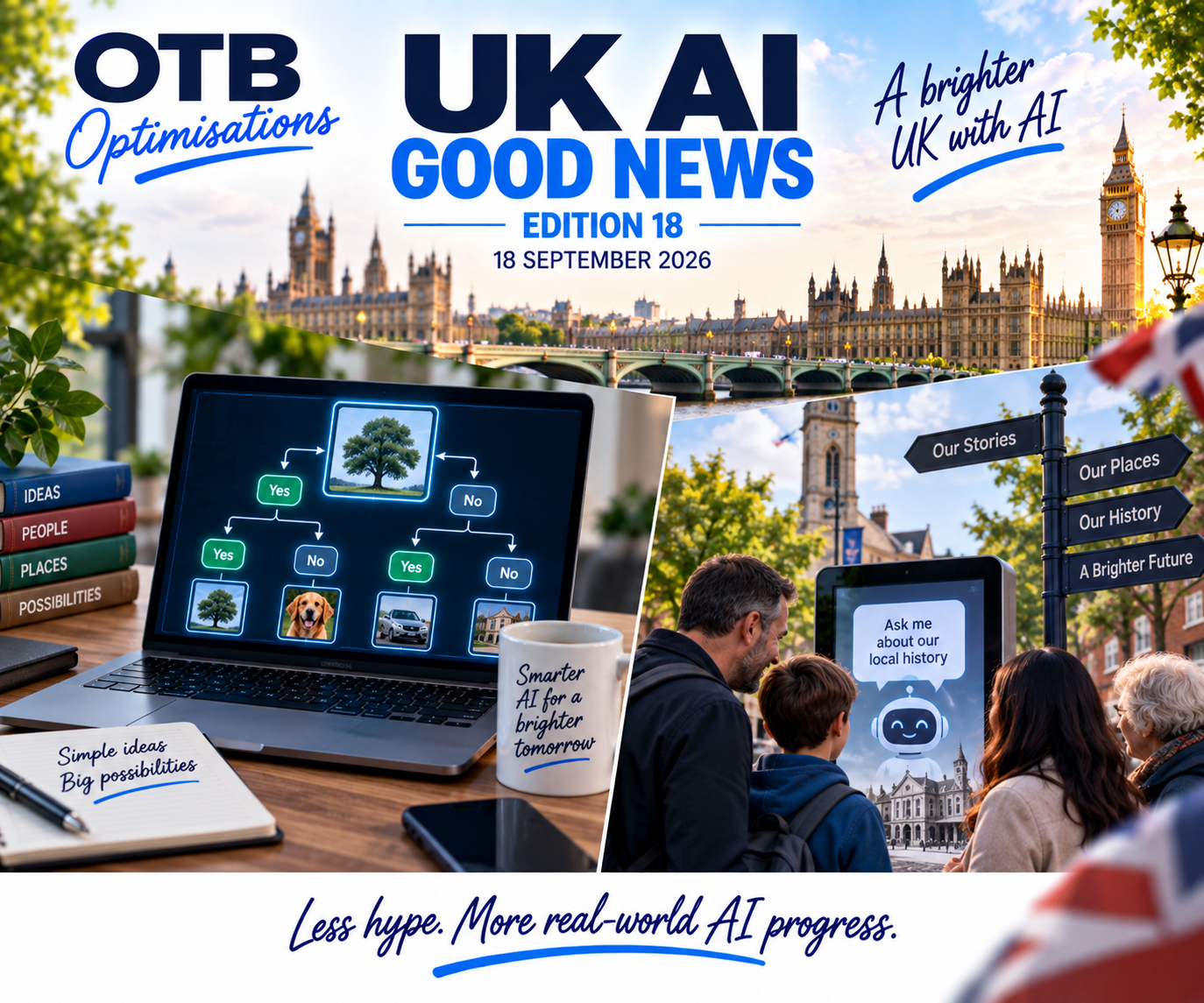
Researchers led by the University of Bristol have developed a new approach to AI image classification inspired by the childhood game 20 Questions.
Instead of building one enormous classifier capable of distinguishing between huge numbers of possibilities, their method breaks the problem into lots of much simpler yes-or-no decisions.
The clever part is that these individual binary classifiers can then be combined to solve much more complicated classification problems.
Researchers say individual classifiers can be trained in minutes on a normal laptop, rather than requiring the specialist computing infrastructure associated with some large-scale AI tasks.
The team mathematically proved the approach and backed it up with experimental testing. Their work suggests it could reduce computational requirements while remaining robust even when some individual answers are wrong.
That could eventually be particularly useful for AI running directly on sensors, robots and smart devices, where access to huge amounts of computing power isn’t practical.
There’s also a potentially important environmental and economic angle.
Much of the current AI race involves bigger models, more GPUs and enormous data centres.
This research asks a very different question:
Could we make the problem simpler instead?
If approaches like this translate successfully into real-world applications, they could help make certain types of AI cheaper and less computationally demanding.
Source: University of Bristol research story, 17 September 2026 ↗
Luton is using AI to bring local history to life
In Luton, AI is being used for something completely different.
A partnership involving the University of Bedfordshire has launched an AI-powered heritage trail around the Brantwood and Dallow area.
Local residents and community groups have helped capture the area’s stories and history, while the university’s Luton AI team has helped turn that knowledge into an interactive digital experience.
Rather than simply reading information from a plaque or webpage, visitors can ask an AI Heritage Guide questions about the area’s people, places and stories.
It’s a relatively small application of AI, but that’s part of what makes it interesting.
Communities contain huge amounts of knowledge in photographs, documents, archives and people’s memories. Used carefully, AI could make that information much easier for people to discover and explore.
The project, supported by the National Lottery Heritage Fund, is now live.
Source: University of Bedfordshire story, 17 September 2026 ↗
Smarter doesn’t always mean bigger
Today’s two stories couldn’t be much more different.
One is exploring a new way of building certain AI systems.
The other is using existing AI technology to help preserve the history of a local community.
But there’s an interesting connection.
Better technology doesn’t necessarily have to mean bigger technology.
Sometimes it’s about finding a simpler way to solve a complicated problem.
Sometimes it’s about taking information that already exists and making it much easier for people to use.
That’s also an important lesson for businesses considering AI.
At OTB Optimisations, the starting point isn’t:
“What AI should we buy?”
It’s:
“What are we actually trying to make easier?”
Start with the problem. Then work out whether AI is the right tool.
No AI for the sake of AI.
Less hype. More real-world AI progress.