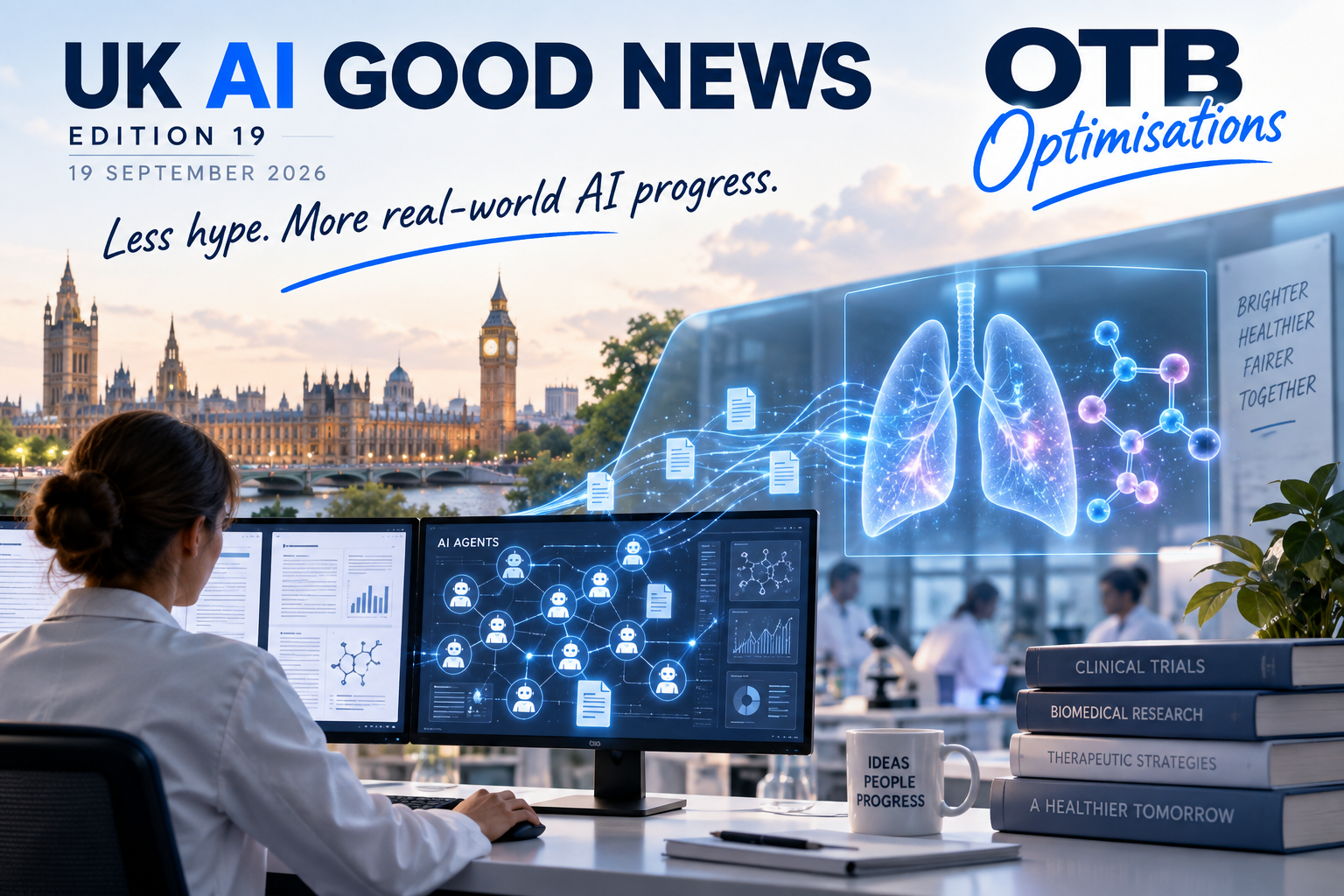
Today’s strongest positive AI development comes from medical research rather than the UK. Fresh UK developments were relatively quiet, so rather than fill the edition with weaker announcements, this one deserves the spotlight.
Researchers at Stanford Medicine have created what they call a Virtual Biotech, effectively an entire drug-development organisation populated by tens of thousands of specialised AI agents.
And what they’ve demonstrated is fascinating.
What happens when 37,000 AI agents become scientists?
Drug development involves an extraordinary amount of information.
Clinical trials, genetics, molecular biology, safety data and scientific literature all need to be analysed before researchers can decide which ideas are worth pursuing.
The Stanford team built an AI organisation designed to divide that work between specialised agents.
At its largest scale, more than 37,000 AI agents were put to work analysing clinical trials.
They catalogued information from around 50,000 trials in less than a week, a task Stanford says would take human researchers years.
The agents then found an interesting pattern.
Drugs aimed at proteins that were highly specific to particular cell types were substantially more likely to succeed in historical clinical-trial data. The researchers reported higher progression through trials and fewer adverse events for drugs fitting those characteristics.
That’s potentially useful because one of the biggest problems in medicine is deciding which promising drug ideas are actually worth spending years and millions of pounds testing.
Then they gave the AI a lung-cancer problem
The researchers also asked their virtual biotech to investigate B7-H3, also known as CD276, a protein already of interest to cancer researchers.
After analysing existing biological data, the AI system proposed targeting B7-H3 with an antibody-drug conjugate, essentially a treatment designed to deliver a toxic payload specifically to cells carrying the target.
Here’s the interesting part.
The AI was restricted to information available before January 2025.
Months later, a pharmaceutical company independently pursued a similar therapeutic strategy. Its treatment subsequently received US FDA Breakthrough Therapy designation after showing effectiveness in a human study.
That doesn’t prove the AI invented a successful cancer medicine.
But it does provide an intriguing independent check that the direction proposed by the system was biologically credible.
What has actually been proven?
This distinction matters.
37,000 AI agents have not cured lung cancer.
The AI system has demonstrated that it can analyse scientific and clinical information at enormous scale, identify patterns associated with historical drug success and propose therapeutic strategies.
Its new candidate targets still need to go into physical laboratories and be experimentally tested.
The Stanford team says that’s exactly what happens next.
So this is research, not a new treatment available to patients.
But it offers a fascinating glimpse of how AI could accelerate one of the slowest and most expensive parts of science.
Sources: Stanford Medicine ↗ · Nature ↗ · Research paper in Science ↗
AI doing the searching, humans doing the proving
There’s something particularly important about this story.
The value isn’t that AI replaces scientists.
It’s that AI can search a volume of evidence that would be extraordinarily difficult for humans to process manually, then give scientists promising directions to investigate.
Humans still have to test those ideas.
Clinical trials still have to demonstrate that treatments are safe and effective.
But if AI can help researchers find better ideas earlier, discard weaker ones sooner and focus precious laboratory time on the most promising candidates, the eventual benefit could be enormous.
That’s a much more interesting vision of AI than another chatbot feature.
Less hype. More real-world AI progress.