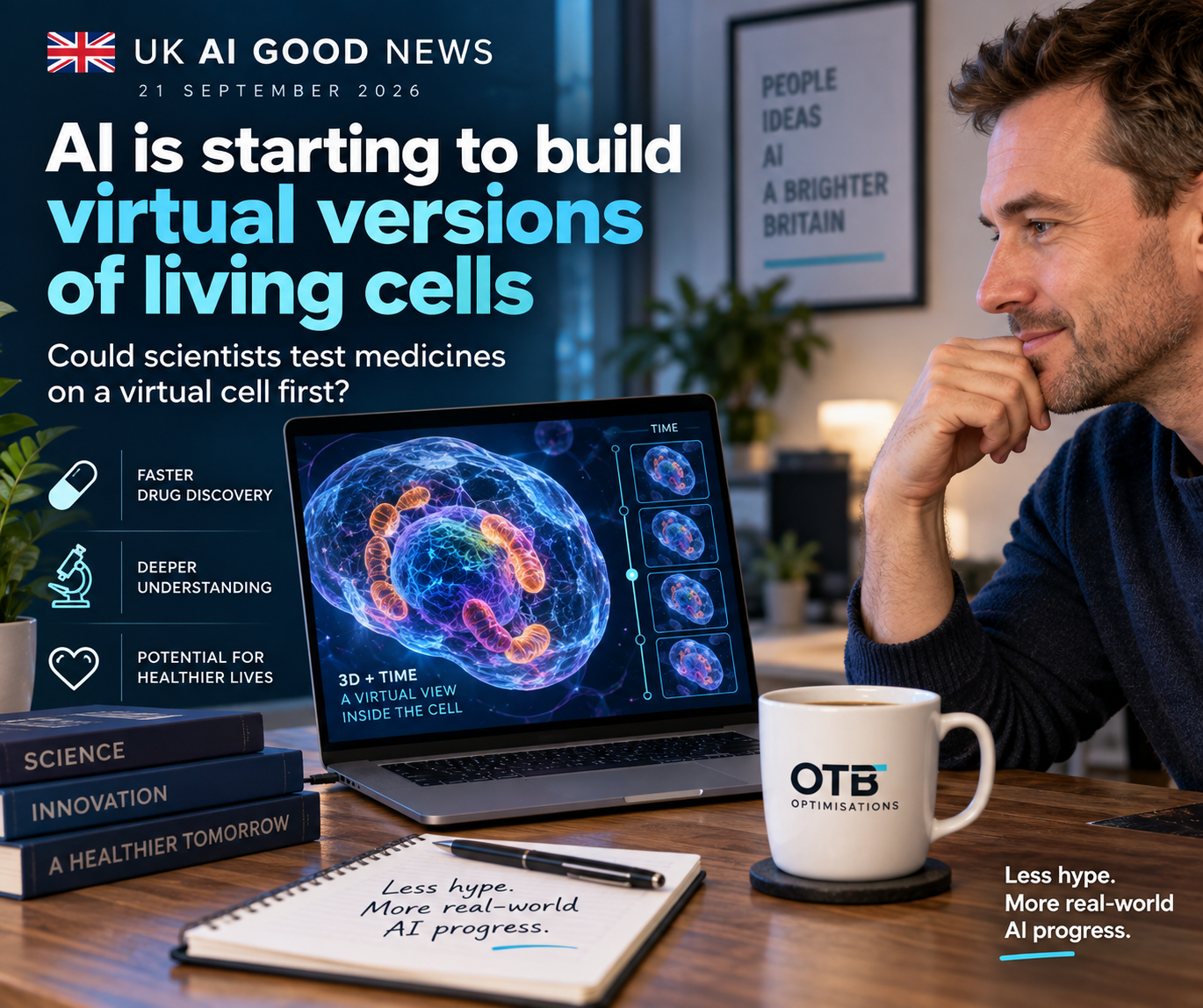
Imagine being able to explore what a potential medicine might do inside a human cell before carrying out every experiment physically in a laboratory.
Researchers at the University of California San Diego are taking an intriguing step towards that future, combining AI, advanced microscopy and digital twins to create virtual versions of living cells.
AI watches cells in four dimensions
Our cells aren’t static.
Structures inside them constantly move, change shape, split and reconnect. But much of traditional cell imaging has relied on flat snapshots.
Researchers have now used advanced microscopy to capture cells in four dimensions: three-dimensional space plus time.
They produced around 40,000 4D movies of individual cancer cells after exposing them to different compounds affecting mitochondria, the structures responsible for producing much of a cell’s energy.
Those movies were then used to train a deep-learning AI model called MitoSpace.
Rather than being told exactly what to look for, MitoSpace learned patterns in how mitochondria changed shape and moved.
And the results were encouraging.
When using the full 4D information, the AI could distinguish drugs and group them by how they worked with 75% accuracy.
Using conventional flat 2D images, that figure was 56%.
Scientists also created a digital twin of a cell
Alongside MitoSpace, the researchers built a physics-based digital twin of a real cancer cell.
Essentially, they created a virtual cell containing rules governing how structures inside the real cell behave.
Then they tested it.
Researchers used a drug to partially disrupt the microscopic tracks that mitochondria use to move around a cell.
Without changing the model’s parameters, the virtual cell reproduced changes in mitochondrial movement and behaviour that were also observed in the real cells.
That’s an important early demonstration that aspects of cell behaviour can potentially be recreated computationally.
Why could this matter for medicine?
Drug discovery involves an enormous amount of physical laboratory experimentation.
If researchers can eventually create sufficiently accurate virtual cells, they could potentially run some experiments computationally first.
AI could search through huge amounts of cellular data and identify interesting patterns.
Digital twins could then help scientists investigate why those patterns are occurring.
Researchers could use that information to decide which ideas are most worthwhile testing physically.
That could potentially reduce some time-consuming laboratory work, help researchers investigate new uses for existing medicines and accelerate the search for new treatments.
The team believes the technology could eventually contribute to research into diseases including cancer, diabetes, Alzheimer’s and mitochondrial disorders.
What could this eventually mean for us?
This research was carried out in the United States, but scientific advances don’t stop at national borders.
If virtual-cell technology develops successfully, researchers in Britain and elsewhere could eventually use similar approaches to investigate diseases and potential medicines.
And it fits into something we’re beginning to see repeatedly with AI and science.
AI doesn’t necessarily need to replace the scientist.
It can give scientists new ways to search, simulate and experiment.
The Stanford research we covered recently showed thousands of AI agents analysing tens of thousands of clinical trials.
Now we’re seeing AI and digital twins beginning to model what happens inside individual living cells.
Different technologies, but the same fascinating possibility:
What if AI can help scientists find the experiments worth doing before they spend years doing them?
That’s potentially where the real impact lies.
Sources: UC San Diego ↗ · Phys.org ↗ · Peer-reviewed research in Cell ↗
But they’re another glimpse of how AI could help scientists understand biology faster and focus their time on the most promising ideas.
Less hype. More real-world AI progress.