Understanding a cancer and finding it earlier are different challenges. Two British announcements this week show how AI could help researchers tackle both, without pretending either has already delivered a new treatment.
On 4 November 2026, Cancer Research UK reported research using AI and advanced cell analysis to explore how glioblastoma brain tumours develop. Separately, the government announced STRIDE-RCT, a large NHS trial evaluating blood tests for possible cancer. Both deserve attention, but they sit at very different stages of evidence.
More Than a Million Cells, From 12 Patients
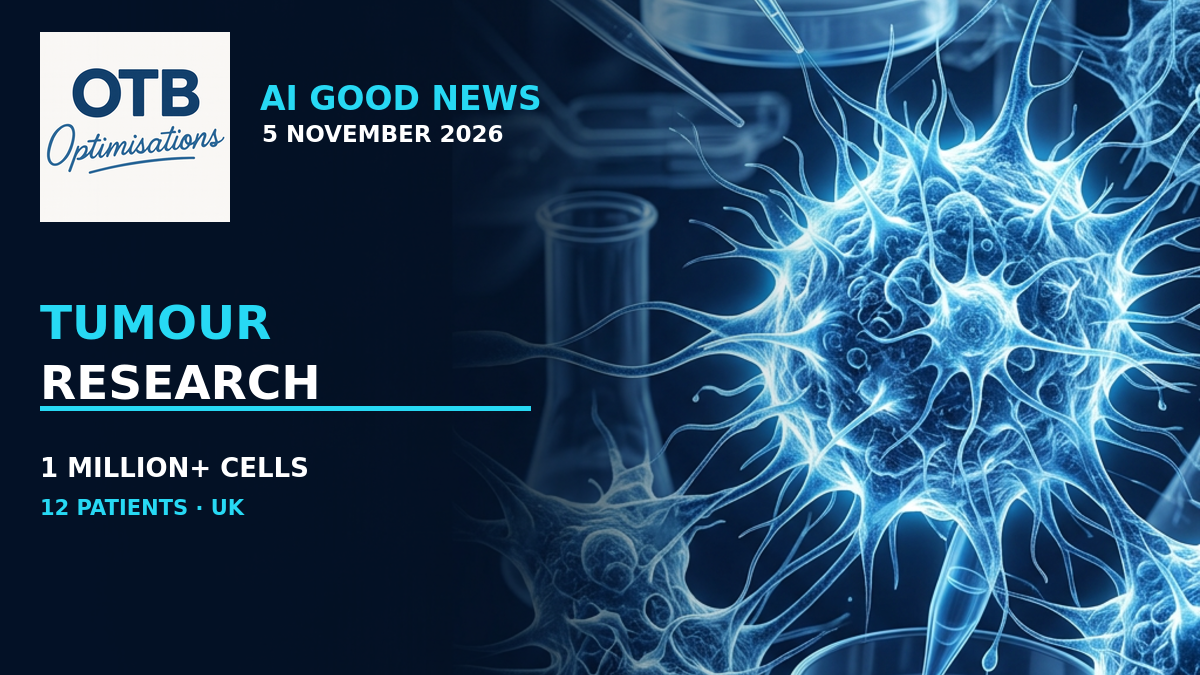
Scientists at the Wellcome Sanger Institute, the Cancer Research UK Cambridge Institute and international partner centres mapped more than one million cells from tumour samples donated by 12 people undergoing treatment for glioblastoma at Cambridge University Hospitals.
The work combined tailored machine-learning tools with single-cell and spatial analysis, imaging and whole-genome sequencing. In plain English, the researchers examined not just what cells were doing, but where they were, their genetic information and the environments surrounding them.
The distinction between cells and patients matters. A million measurements offer extraordinary biological detail, but they do not turn a 12-patient study into a million-patient clinical trial.
A Pattern in a Difficult Disease
The study, published in Nature on 4 November, identified a recurring pattern of tumour organisation. Early developmental-like cells sit towards the advancing edge. Other cells take on injury-response states, while cells deeper in oxygen-deprived regions shift into survival states that can resist treatment.
Researchers checked the proposed developmental roadmap using laboratory-grown brain organoids. A companion paper explored the regulatory switches associated with changes between cell states. The freely accessible GBM-Space atlas gives other scientists a resource for investigating these findings.
That could help researchers design future treatments aimed at several tumour states or the environments supporting them. It does not mean they have produced such a treatment, established its safety or shown that patients live longer. This is foundational biological research, not a cure announcement.
A Separate NHS Trial Asks a Practical Question
STRIDE-RCT will recruit more than 20,000 NHS patients across at least 200 GP practices in England, with up to £8.49 million in government funding through the Office for Life Sciences and NIHR.
The 4 November announcement describes patients aged 45 and over visiting their GP with abdominal symptoms, such as persistent bloating or discomfort. This is not an announcement of population-wide screening for people without symptoms.
The trial will evaluate blood tests that look for signs of several cancers and may suggest where in the body those signals originate. The technologies vary, including some using AI and others measuring proteins. It would be misleading to describe every test as the same AI system.
A Blood-Test Signal Is Not a Diagnosis
A positive result would help a GP and patient decide whether an urgent referral is appropriate. It would not, by itself, confirm cancer. The tests must be assessed alongside clinical judgement and the existing diagnostic pathway.
Useful evaluation needs to consider missed cancers, false alarms, follow-up investigations and whether patients receive the right care sooner. Those are questions the trial is intended to answer, not benefits already demonstrated by its launch.
Why This Is Good News
One project makes a difficult disease more understandable. The other commits to testing promising diagnostic tools in routine general practice, including a range of communities. The common strength is not an extravagant AI claim, but a clearer route to evidence.
For patients and families, hope should come with an honest account of what remains unknown. Better maps and well-designed trials are meaningful progress precisely because they help establish what might genuinely work.
Sources and Further Reading
- Cancer Research UK: Scientists uncover the hidden rules behind glioblastoma. Published 4 November 2026. Original charity announcement covering the cells, patients, biological patterns and research limitations.
- GOV.UK: New NHS blood test trial to help spot cancers earlier. Published 4 November 2026. Original STRIDE-RCT announcement, eligibility, recruitment plans, funding and diagnostic caveats.
- Wellcome Sanger Institute: Uncovering rules for aggressive brain tumours. Published 4 November 2026. Additional methods and links to the two Nature papers.
- Nature: A spatiotemporal cancer cell trajectory underlies glioblastoma heterogeneity. Published 4 November 2026, as linked by both Cancer Research UK and Sanger. The account above follows their verified explanations.
Less hype. More real-world AI progress.