There are some genuinely encouraging AI developments to talk about today, both here in Britain and further afield.
And what I like about these stories is that they’re not really about making AI more impressive.
They’re about making it useful.
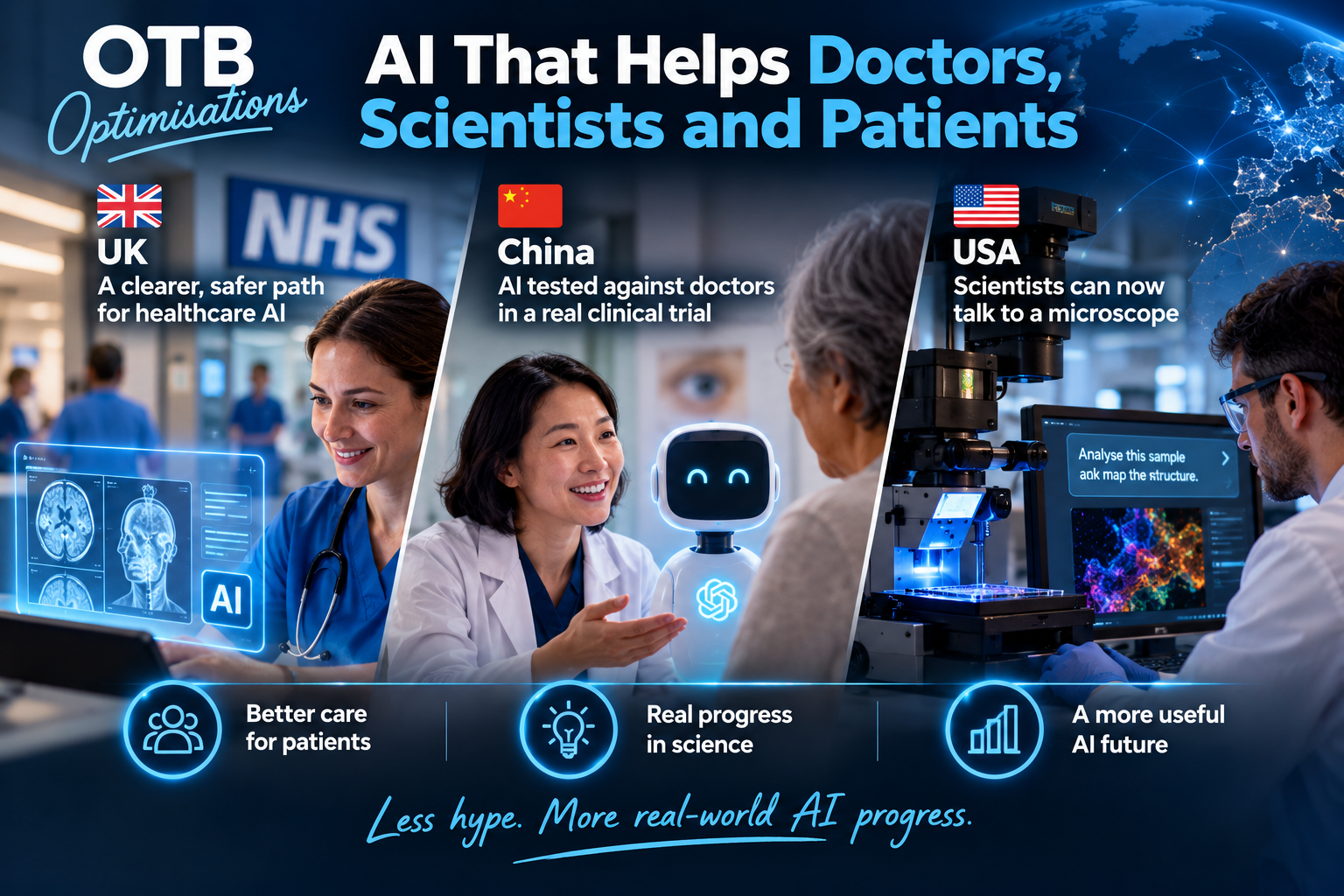
🇬🇧 Britain is changing how healthcare AI reaches patients
The UK Government has today accepted all 44 recommendations from the independent National Commission into the Regulation of AI in Healthcare.
The basic challenge is a fascinating one.
Traditional medical devices can be assessed as relatively fixed products. AI systems can be updated, retrained and change over time.
So instead of simply approving healthcare AI and assuming the job is finished, the new approach puts much greater emphasis on continuing to monitor safety and performance after the technology has been introduced into real healthcare settings.
It also includes checking whether AI works safely and effectively for different groups of people, clearer accountability when something goes wrong and better information for patients about how AI is being used.
But importantly, this isn’t just about adding more regulation.
The Government also wants clearer routes for genuinely useful AI to reach patients, better guidance for healthcare organisations and an AI Readiness Toolbox to help staff introduce these systems safely.
This isn’t a new medical breakthrough in itself.
It’s about creating the infrastructure that could allow future breakthroughs to reach patients faster while continuing to check that they actually work.
And that feels like a pretty sensible approach.
👁️ AI has now been tested against doctors in a randomised clinical trial
This next one really caught my attention.
Researchers in China have conducted a randomised clinical trial involving 172 patients comparing an AI agent with ophthalmology residents for taking patients’ medical histories before their consultation.
And the results were impressive.
The AI achieved a significantly higher score for the quality of the medical history it collected.
Patients also rated the AI higher for patience and empathy.
Interestingly, the AI spent considerably longer talking with patients, a median of 11.2 minutes compared with 3.1 minutes for the doctors.
That doesn’t mean AI is a better doctor.
In fact, the study points towards something much more useful.
The researchers suggest a hybrid approach, where AI handles some of the structured information gathering while doctors concentrate their expertise on physical examination, diagnosis and clinical judgement.
That is exactly the sort of AI application I find interesting.
Not:
“How do we replace the doctor?”
But:
“What can we remove from the doctor’s workload so they can spend more time being a doctor?”
And funnily enough, that connects almost perfectly with what I wrote on 4 October.
Use AI to get you to the valuable part of your job faster.
🔬 Scientists can now talk to a microscope
Meanwhile, researchers at the US Department of Energy’s Argonne National Laboratory have demonstrated an AI system that can help control extremely sophisticated scientific experiments using ordinary language.
Rather than scientists having to write code or enter complex technical commands, they can tell the AI what they want to investigate.
The system can then help handle data collection, processing and analysis.
This has already been demonstrated using facilities including Argonne’s Advanced Photon Source and Center for Nanoscale Materials.
And there’s a bigger idea hiding inside this.
For years we’ve mainly talked about AI analysing scientific data after an experiment has happened.
We’re now starting to see AI becoming part of the experimental process itself.
A scientist asks the question.
AI helps operate the equipment and process the information.
The scientist interprets what it means and decides where the research goes next.
Again, it’s not about removing the human.
It’s about removing some of the complexity between the human and the thing they’re actually trying to discover.
There’s a pattern emerging here
These three stories are happening in completely different places.
Healthcare regulation in Britain.
An eye hospital in China.
A national laboratory in America.
But they all point towards roughly the same version of AI.
AI working alongside people rather than simply replacing them.
Help the doctor gather the information.
Help the scientist operate incredibly complicated equipment.
Help healthcare organisations introduce new technology safely.
And then leave the important judgement, responsibility and decision-making with people.
That’s a version of the AI future I’m quite happy to get behind.
Less hype. More real-world AI progress.
Sources
- UK Government: Response to the National Commission on AI in Healthcare ↗ — 6 October 2026.
- UK Government: What the recommendations mean for patients ↗ — 6 October 2026.
- npj Digital Medicine: Randomised ophthalmology clinical trial ↗ — published 5 October 2026.
- Argonne National Laboratory: AI turns language into self-guided experimentation ↗ — 5 October 2026.