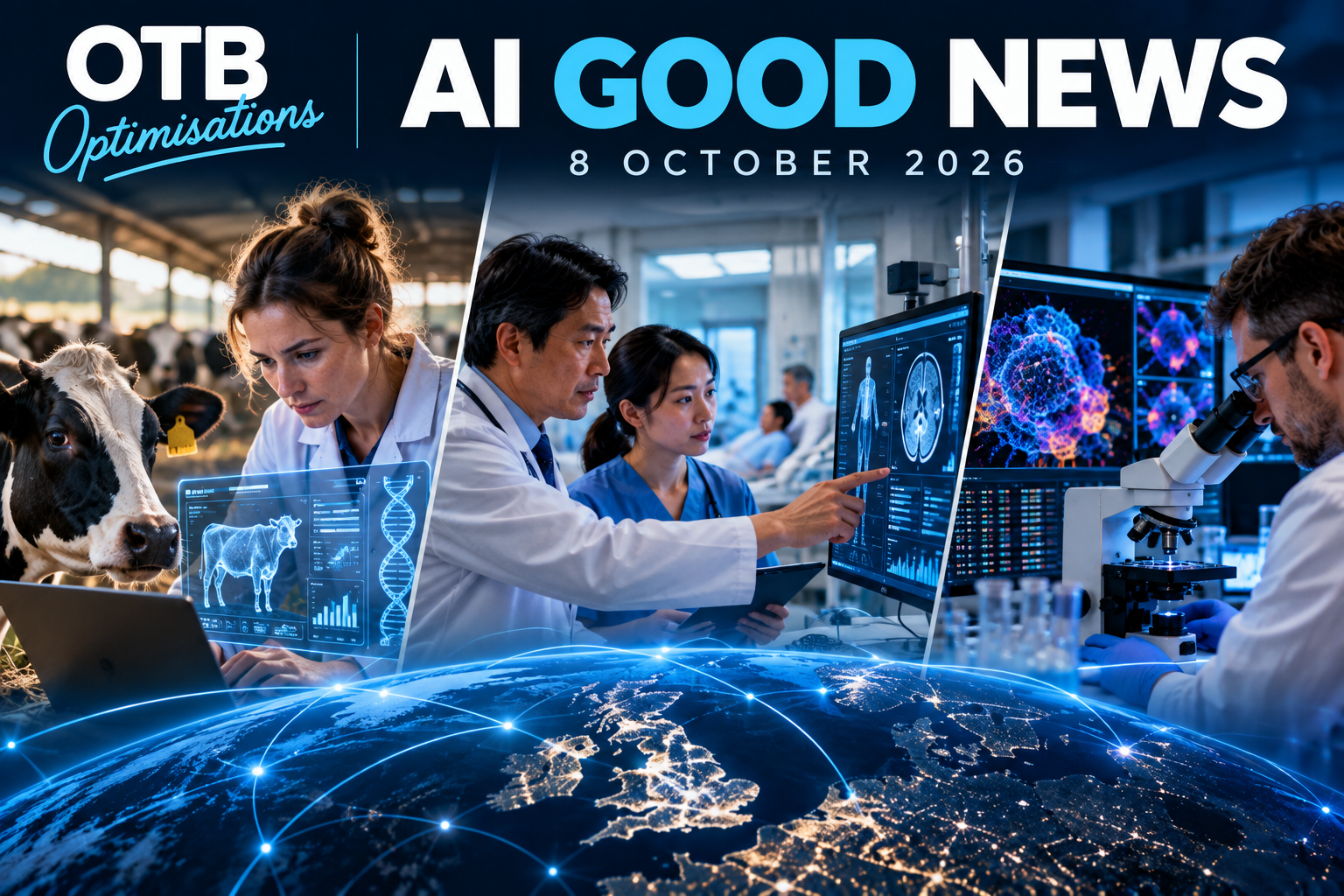
What if AI could help scientists prepare vaccines before the next major disease outbreak? Or allow doctors and nurses to spend less time on paperwork and more time caring for patients?
Three developments reported on 7 October show how those possibilities are beginning to take shape.
From British vaccine research to hospitals in South Korea and a major international effort to understand human biology, AI is increasingly being directed towards solving real problems.
🇬🇧 1. Britain backs AI research to help fight future diseases
The UK Government and UK Research and Innovation announced more than £54 million for 18 research projects aimed at improving protection against biological threats.
One particularly interesting project, led by Professor Jonathan Heeney at the University of Cambridge, will use artificial intelligence to help develop adaptable vaccine components against animal diseases and infections that can spread between animals and humans.
The idea is to make vaccine development more flexible when new threats emerge.
Other projects will investigate antibiotic resistance, disease outbreaks and new veterinary vaccine technologies.
Why does this matter?
Diseases affecting livestock can devastate farms, disrupt food supplies and create serious economic consequences. Some animal infections can also threaten human health.
Using AI to help identify promising vaccine targets could eventually shorten parts of the research process.
However, this is newly funded research, not an announcement that an AI-designed vaccine has already been proven effective.
And importantly, the £54 million supports the entire research programme, not AI alone.
Source: UKRI: UK government and UKRI invest £54m to tackle biosecurity threats ↗ — 7 October 2026.
🏥 2. A hospital in South Korea shows what practical AI adoption looks like
A fascinating report published yesterday by the UK’s The Health Foundation examined how a major hospital in Seoul is already using AI across its operations.
At Samsung Medical Center, AI is being used for tasks including medical-record summaries, drafting documents, scheduling procedures, supporting clinical risk prediction and managing patient information.
There’s even an internal AI assistant that helps staff find hospital procedures and answer workplace questions.
But the most interesting part isn’t the technology.
It’s how the hospital introduced it.
When staff began using AI-assisted wound imaging, they needed training, testing and a gradual rollout. The system was introduced to small teams before being expanded throughout the hospital.
The hospital also encourages employees to suggest problems that technology might help solve.
That is an important lesson for British healthcare organisations and, frankly, any business.
Don’t introduce AI simply because it’s available.
Find the problem, involve the people doing the work, test the solution and improve it.
These are examples of systems already operating, although the report does not establish a quantified improvement in patient outcomes.
Source supplied: The Health Foundation, 7 October 2026. Visit the publisher ↗.
🔬 3. A $1.8 billion international effort aims to teach AI how human cells work
This could become one of the most important long-term AI research projects in medicine.
On 7 October, Biohub announced an expanded international collaboration involving the US Department of Energy, National Institutes of Health and major technology research partners.
The combined commitment totals approximately $1.8 billion in funding, existing research resources, computing and scientific infrastructure.
The goal?
To create enormous, standardised collections of biological data that researchers can use to develop AI models capable of predicting how living cells respond to different conditions and treatments.
Imagine scientists investigating how a particular treatment might affect human cells.
Today, answering those questions can require extensive laboratory experiments.
In the future, sufficiently accurate AI models might help researchers investigate possibilities digitally before deciding which physical experiments to conduct.
That could eventually accelerate research into diseases and potential treatments.
There’s another positive aspect.
The initiative aims to make biological datasets available to the wider scientific community, although some access restrictions will apply initially.
This is a major investment in research infrastructure, not a demonstrated cure or a finished virtual-cell model.
But it’s a significant commitment to building the scientific foundations that future medical discoveries may depend on.
Source: Biohub: International collaboration to build foundational data for AI models of biology ↗ — 7 October 2026.
The bigger picture
These stories have something important in common.
In Britain, researchers want AI to help prepare for diseases before they become major problems.
In South Korea, hospitals are already finding practical ways to incorporate AI into everyday work.
And internationally, scientists are investing in the data and infrastructure needed to understand biology in entirely new ways.
Different applications, but the same underlying principle.
AI becomes valuable when it helps people achieve something useful.
Not when it produces the most impressive demonstration.
Not when it replaces a human simply because it can.
But when it removes complexity, accelerates discovery or helps people do their jobs better.
Some of today’s developments are already being used. Others are ambitious research programmes that still need to prove themselves.
Both matter, provided we understand the difference.
Less hype. More real-world AI progress.